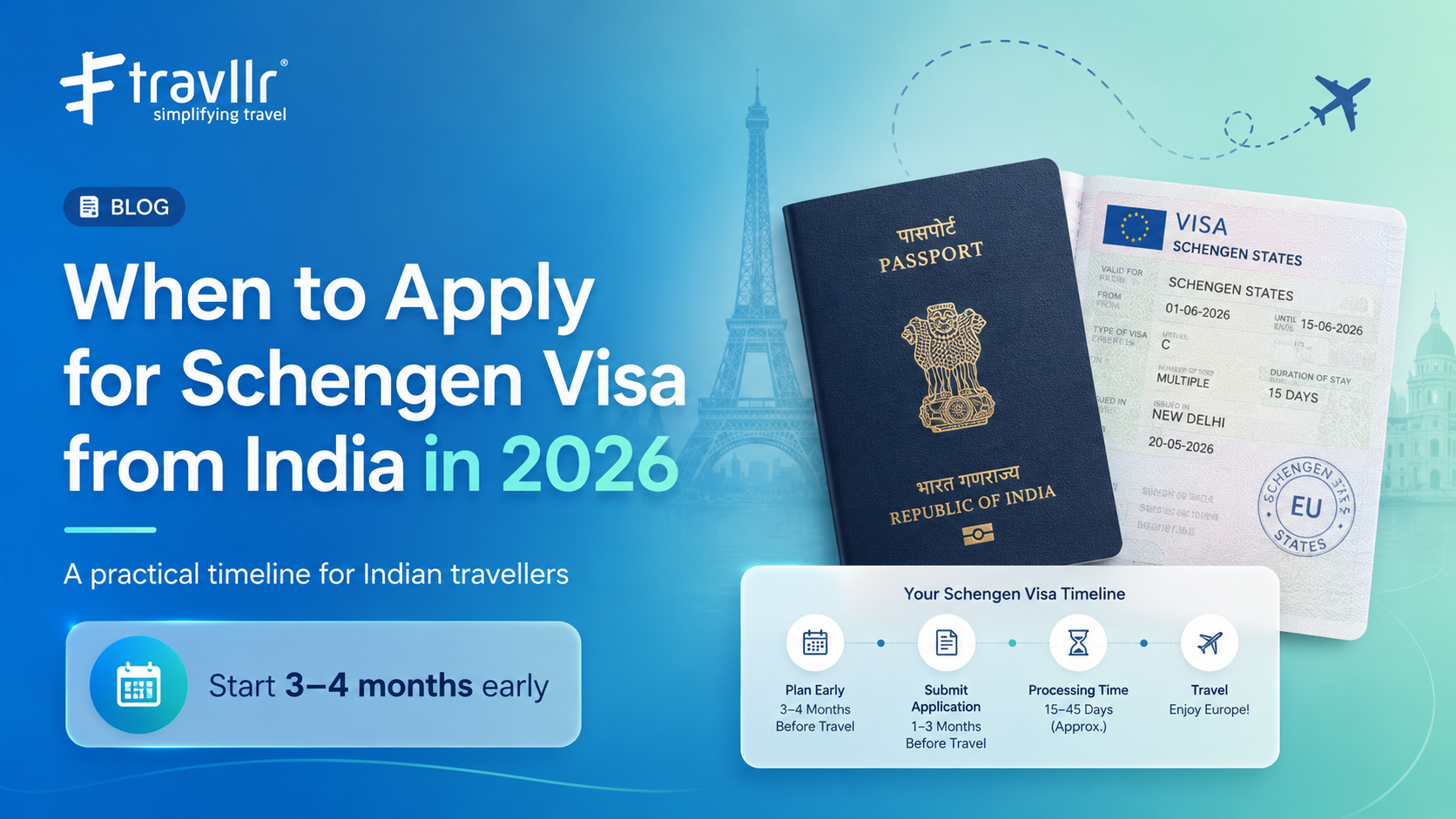
For a Europe trip in 2026, Indian travellers should start Schengen visa planning at least 3 to 4 months before travel, especially for summer, Diwali, Christmas and large family trips. Officially, Schengen visa applications can be submitted no earlier than 6 months and at least 15 days before travel, but in real life, appointment delays, document corrections and peak-season demand can make last-minute planning risky.
Why This Matters for Indian Travellers
Europe planning usually starts with excitement.
- Paris.
- Switzerland.
- Italy.
- Austria.
- Family photos.
- Snow mountains.
- Cruises.
- Shopping.
- Jain food.
- Full dream trip.
- Then one word creates stress:
Visa.
For many Indian travellers, the Schengen visa is not difficult because the form is impossible. It becomes stressful because of timing.
- Appointments may not be available when you want them.
- Documents may need correction.
- Hotel bookings may need to match the itinerary.
- Flight dates may need to be sensible.
- Bank statements must look clean.
- Travel insurance should be correct.
- And if you are travelling as a family of 4, 8 or 12 people, one small delay can affect everyone.
- That is why this guide is simple:
Do not treat the Schengen visa like the last step.
Treat it like the first real step of your Europe trip.
Schengen Visa Appointment India 2026: Quick Timeline
| Travel Month | Start Planning | Ideal Appointment Window | Risk Level |
|---|---|---|---|
| March 2026 | Nov–Dec 2025 | Dec–Jan | Medium |
| April 2026 | Dec–Jan | Jan–Feb | High because of spring travel |
| May 2026 | Jan–Feb | Feb–Mar | Very high |
| June 2026 | Jan–Feb | Feb–Apr | Very high |
| July 2026 | Feb–Mar | Mar–May | Very high |
| August 2026 | Mar–Apr | Apr–Jun | High |
| September 2026 | May–Jun | Jun–Jul | Medium |
| October 2026 | Jun–Jul | Jul–Aug | Medium/high for festive trips |
| November 2026 | Jul–Aug | Aug–Sep | Medium |
| December 2026 | Aug–Sep | Sep–Oct | High for Christmas/New Year |
Travllr rule: If your trip is during peak season, start visa planning 4 months before travel. If you are a large family or first-time Schengen applicant, start even earlier.
What Is the Official Schengen Visa Rule?
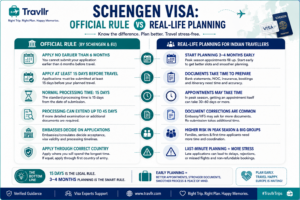
A Schengen visa allows non-EU travellers to make a short temporary visit of up to 90 days in any 180-day period in the Schengen area. The European Commission also says travellers visiting more than one Schengen country should apply through the country where they will spend the longest time; if the stay length is equal, apply through the first country of entry.
For timing, the official rule is:
- You must apply at least 15 days before travel.
- You cannot apply earlier than 6 months before travel.
- You may need to book an appointment before lodging the application.
- Now here is the important part.
The official rule is the legal window.
But for Indian travellers, the practical planning window is different.
Because getting an appointment, preparing documents and correcting mistakes can take time.
Why 15 Days Is Too Late in Real Life
Officially, 15 days may sound enough.
But for a real Europe holiday, it is not safe.
Here is why:
- You may not get an appointment immediately.
- Your documents may not be ready.
- Your bank statement may need correction.
- Your hotel bookings may not match your route.
- Your employer NOC may take time.
- Your travel insurance may need changes.
- Your family members may need separate paperwork.
- Your passport may need renewal.
- Your application may require additional documents.
The European Commission says the normal processing time is 15 days, but it can extend up to 45 days if more detailed examination or extra documents are required.
So if you apply too late, you are not just taking one risk.
You are stacking many risks together.
What Is Happening in 2026?
In February 2026, Times of India reported that travel agents in Gujarat were seeing Indian Europe travellers book much earlier because of Schengen visa delays and appointment uncertainty. The report quoted a travel company owner saying appointments were taking 45–60 days just to get, while families were starting Europe bookings in January for summer travel instead of waiting until March.
This does not mean every Indian traveller everywhere will face the same delay.
But it shows the real pattern:
- Peak Europe travel = appointment pressure.
- Large families = higher timing risk.
- First-time applicants = more document work.
- Last-minute planning = more stress.
So the safest advice is clear.
If Europe is fixed in your mind, do not wait for “later”.
Start early.
VFS Global’s 2026 Advice: Apply Early and Avoid Fraud
In February 2026, VFS Global advised Indian travellers to apply well in advance and said many countries allow visa applications up to 180 days before travel. It also warned travellers to use only official channels for appointments and avoid third-party claims, because VFS said it does not sell appointment slots or provide priority access through outside parties.
This is very important.
When appointments are hard to find, travellers become desperate.
That is when fraud risk increases.
Avoid anyone who says:
- “I can guarantee appointment.”
- “I have internal VFS contact.”
- “I can guarantee visa approval.”
- “Pay me extra and I will get priority slot.”
- “Embassy approval confirmed.”
- VFS has also stated that embassies and consulates alone decide whether to accept or refuse visa applications, determine visa validity and set processing timelines.
So do not trust shortcuts.
Trust correct documents and early planning.
Best Time to Apply for Schengen Visa from India
| Traveller Type | When to Start | Why |
|---|---|---|
| Solo traveller with strong travel history | 2.5–3 months before travel | Lower coordination risk |
| Couple travelling to Europe | 3 months before travel | Flights, hotels and documents need alignment |
| Family with kids | 3–4 months before travel | More documents and school holiday rush |
| Senior citizens | 3–4 months before travel | Insurance, medical and comfort planning |
| First-time Schengen applicant | 4 months before travel | Higher document correction risk |
| Large family or group | 4–5 months before travel | Appointment coordination is harder |
| Summer Europe traveller | 4 months before travel | Peak demand |
| Diwali/Christmas traveller | 4 months before travel | Holiday crowd and higher fares |
Simple rule: The bigger the group, the earlier you should start.
Document Checklist for Schengen Visa from India
A Schengen visa is not only about filling one form.
Your documents must tell one clear story:
- Who you are.
- Why you are travelling.
- How you will pay.
- Where you will stay.
- When you will return.
The European Commission lists key documents such as a valid passport, visa application form, compliant photo, medical insurance, purpose-of-stay documents, financial proof, accommodation proof and proof that you intend to return after your stay. Fingerprints are also collected when the application is submitted, with some exemptions.
Basic Document Checklist
| Document | What to Check |
|---|---|
| Passport | Valid for at least 3 months after leaving Schengen |
| Visa form | Correct details, no spelling mistakes |
| Photos | As per required standards |
| Travel insurance | Emergency medical care, hospitalisation and repatriation cover |
| Flight booking | Dates should match itinerary |
| Hotel booking | City-wise stays should match route |
| Bank statement | Clean and sufficient funds |
| ITR/Form 16 | Supports financial stability |
| Employment proof | Salary slips, leave approval, NOC |
| Business proof | GST, registration, ITR, bank records |
| Cover letter | Explains route and purpose clearly |
| Day-wise itinerary | Must match hotel and flight details |
| Previous visas | Useful if available |
| Minor documents | Birth certificate, school ID, parent consent where needed |
Common Reasons Schengen Visa Applications Become Weak
No one can guarantee a visa.
But many applications become weaker because of avoidable mistakes.
1. Unclear itinerary
If your hotel bookings, travel dates and route do not match, the application looks confusing.
2. Weak financial documents
Bank balance alone is not enough. The statement should look stable and explainable.
3. Last-minute booking
Rushed applications often have missing or incorrect documents.
4. Wrong embassy choice
If you are spending the longest time in Switzerland but applying through another country only because appointments are easier, that can create risk.
5. Missing employer documents
For salaried travellers, leave approval, NOC and salary proof matter.
6. Poor cover letter
A good cover letter should explain the trip simply, not sound copied from the internet.
7. Unrealistic route
A 9-day trip covering 6 countries may look impractical.
8. No clear return reason
The application should show why you are likely to return to India.
Rejection Risk: What 2025 Data Shows
In May 2026, Economic Times reported European Commission statistics showing that Indian applicants filed 1,153,748 Schengen visa applications in 2025, and 181,111 of them did not result in visas, creating an overall 15.8% non-issuance rate. The report also noted that outcomes varied by destination country, with some countries having much higher non-issuance rates than others.
This does not mean you should be scared of applying.
It means you should be serious.
A Schengen visa is not a casual checklist.
It needs clean documents, correct route logic and honest planning.
Which Schengen Country Should You Apply To?
Apply to the country that matches your actual trip.
Not the country that looks easiest.
Officially:
If you visit one Schengen country, apply to that country.
If you visit multiple Schengen countries, apply where you spend the longest time.
If stay duration is equal, apply through the first country you enter.
Example 1
Paris 3 nights
Switzerland 5 nights
Italy 3 nights
Apply through Switzerland, because that is your longest stay.
Example 2
France 3 nights
Switzerland 3 nights
Italy 3 nights
Apply through the first Schengen entry country.
Example 3
You got an appointment for another country, but your route does not match.
Do not force it.
Fix the route properly or speak to a visa expert before applying.
Schengen Visa Fee for Indians in 2026
The European Commission lists the Schengen visa fee as €90 for adults and €45 for children aged 6–12. It also says an additional fee may apply if applications are handled through visa service centres.
For Indian travellers, the real cost may include:
- Visa fee
- VFS/service centre fee
- Travel insurance
- Courier service if selected
- SMS service if selected
- Photos
- Printouts
- Bank documents
- Travel to visa centre if needed
So do not budget only the embassy fee.
Keep a practical visa-and-document buffer.
Schengen Visa Timeline: What Travllr Recommends
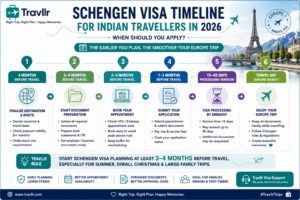
| Stage | Ideal Timing Before Travel | What to Do |
|---|---|---|
| Destination + route finalisation | 120 days | Decide countries, nights and entry/exit |
| Passport check | 120 days | Check validity and blank pages |
| Package/hotel plan | 100–110 days | Keep route realistic |
| Document collection | 90–100 days | Bank, ITR, NOC, employment/business proof |
| Appointment search | 90–120 days | Start checking early |
| Application submission | 60–90 days | Submit with complete documents |
| Passport return buffer | 30–45 days | Avoid travel panic |
| Final tickets/optional tours | After visa or as per refund comfort | Avoid non-refundable risk where possible |
This is the safe way.
Not the last-minute way.
Should You Book Flights Before Visa?
This depends on the destination, package rules and your risk comfort.
Many visa applications require travel details, but that does not mean you should blindly book non-refundable flights without thinking.
Ask these questions:
- Are the tickets refundable?
- Are date changes allowed?
- What happens if the visa is delayed?
- What happens if one family member gets delayed?
- Is the package protected?
- Are hotel bookings cancellable?
- Does your travel insurance cover visa-related issues?
- Is the itinerary realistic?
For Europe, refundable or flexible planning is often worth considering.
Saving ₹5,000 on a non-refundable booking can become expensive if the visa timeline goes wrong.
First-Time Applicants: Extra Care Needed
If you are applying for a Schengen visa for the first time, be more careful.
- You may need to attend in person for biometrics.
- You may have no previous travel history.
- Your financial documents need to be strong.
- Your route should be simple and believable.
- Your cover letter should be clear.
- Your hotel and flight plan should match perfectly.
- Do not overcomplicate your first Europe trip.
A clean France–Switzerland–Italy route is better than trying to show 8 countries in 10 days.
The visa officer should understand your trip in one reading.
Large Family and Group Applications
Large family trips need even earlier planning.
Why?
- Because every person needs documents.
- Every passport must be checked.
- Every bank statement must be collected.
- Every employment or business proof must be aligned.
- Every child or senior traveller may need extra documents.
- Every appointment should ideally fit the travel timeline.
For a family of 10 or 12 people, do not start in the last month.
Start early, or the trip may become stressful before it even begins.
Refund and Cancellation Planning
Before paying for a Europe package, ask:
- What if visa appointment is delayed?
- What if visa is rejected?
- What if one person gets visa and another does not?
- What part of the package is refundable?
- What part is non-refundable?
- Are flights issued immediately?
- Are hotels cancellable?
- Are visa fees refundable?
- Is insurance refundable?
- Are service charges refundable?
This must be clear before payment.
Not after rejection.
Fraud Warning: Do Not Buy Fake Appointment Shortcuts
When Schengen appointments become difficult, fake promises increase.
Be careful of:
- Paid “guaranteed” appointment slots
- Agents claiming embassy/VFS inside access
- Social media visa payment links
- Fake appointment letters
- Fake document makers
- Guaranteed approval claims
- Urgent cash transfer requests
Use official appointment routes and verified travel partners only.
A real travel company can help you prepare properly.
It cannot force embassy approval.
That line is very important.
How Travllr Can Help
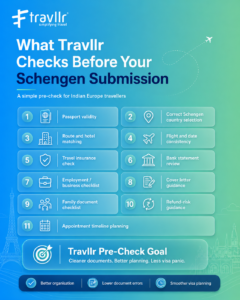
Travllr’s Schengen document pre-check should focus on preventing basic mistakes before submission.
A good pre-check includes:
- Passport validity
- Correct Schengen country selection
- Route and hotel matching
- Flight and date consistency
- Travel insurance check
- Bank statement review
- Employment/business document checklist
- Cover letter guidance
- Family document checklist
- Refund-risk guidance
- Appointment timeline planning
This does not mean visa approval is guaranteed.
It means the application becomes cleaner, more organised and less rushed.
That is the real value.
Travllr Verdict
For Indian travellers planning Europe in 2026, the safest answer is simple:
Start Schengen visa planning early.
Do not wait until flights are expensive, appointments are full and documents are rushed.
Officially, you can apply up to 6 months before travel and at least 15 days before travel. But practically, Indian families, first-time applicants and summer Europe travellers should begin planning 3 to 4 months in advance.
Travllr recommends early planning because Europe is not only about getting a visa.
It is about building a trip where the visa, flights, hotels, route, food and refund terms all make sense together.
If your documents are strong and your plan is clean, you travel with more confidence.
If your documents are rushed, Europe becomes stressful before it even starts.
FAQs
1. When should Indians apply for a Schengen visa in 2026?
Indian travellers should ideally start Schengen visa planning 3 to 4 months before travel, especially for Europe summer holidays, Diwali, Christmas and family trips. Officially, Schengen applications can be submitted no earlier than 6 months and at least 15 days before travel.
2. Are Schengen visa appointments delayed in India in 2026?
There have been reports of appointment pressure and early Europe bookings in 2026. Times of India reported travel agents in Gujarat saying some travellers were facing 45–60 day appointment waits during peak planning periods. This may vary by country, city and season, so travellers should check early.
3. How long does Schengen visa processing take?
The European Commission says normal Schengen visa processing time is 15 days, but it can extend up to 45 days if a more detailed examination or additional documents are required.
4. Can I apply for Schengen visa 6 months before travel?
Yes. The European Commission says you must submit your application no earlier than 6 months before travel and at least 15 days before the intended journey.
5. Which Schengen country should I apply through?
Apply through the Schengen country where you will spend the longest time. If you are spending equal time in multiple countries, apply through the first Schengen country you will enter.
6. What is the Schengen visa fee for Indians in 2026?
The European Commission lists the Schengen visa fee as €90 for adults and €45 for children aged 6–12. Extra service-centre fees may apply if applications are submitted through visa service centres.
7. Can VFS or a travel agent guarantee my visa?
No. VFS has stated that embassies and consulates alone decide whether to accept or refuse applications, determine visa validity and set processing timelines. No travel agent should promise guaranteed approval.
8. Should I book refundable flights for Schengen visa?
For many Indian travellers, refundable or flexible bookings are safer, especially if the appointment timeline is uncertain. Before booking, check cancellation terms, date-change charges and what happens if the visa is delayed or refused.
Conclusion
A Europe trip should start with excitement, not visa panic.
The easiest way to avoid panic is to start early.
- Do not wait until the last month.
- Do not trust appointment shortcuts.
- Do not submit messy documents.
- Do not choose the wrong embassy only because a slot is available.
- Do not book blindly without checking refund terms.
For 2026, the smart Europe planning formula is:
Route first. Documents early. Appointment early. Refund rules clear. Visa pre-check before submission.
That is how Indian travellers should plan Schengen visas.
Get Travllr’s Schengen document pre-check before you submit your Europe visa application.