A Meghalaya itinerary 6 days works best when you keep the route simple: Guwahati → Shillong → Cherrapunji/Sohra → Nongriat Living Root Bridge → Dawki/Shnongpdeng → Mawlynnong → Shillong/Guwahati.
This route gives you waterfalls, caves, cloudy roads, clean villages, the Umngot River, living root bridges and enough breathing space. For Indian families, couples and first-time North East travellers, 6 days gives a strong Meghalaya experience without rushing every day.
Why Meghalaya Works So Well for Indian Travellers
Meghalaya feels cinematic.
Clouds move across roads.
>Waterfalls appear suddenly.
Villages feel clean and peaceful.
Caves feel mysterious.
>Dawki looks unreal in the right season.
>Living root bridges feel like something from another world.
It is one of the best North East trips for people who want nature without making the journey too difficult.
Meghalaya also works better than many mountain destinations for first-time families because the route can stay flexible. You do not need high-altitude acclimatisation like Ladakh. You do not need snow-road stress like parts of Sikkim. You do not need very remote road journeys like Arunachal.
But Meghalaya still needs planning.
Rain can change the experience.
Road travel takes time.
Some waterfalls need careful access.
Nongriat needs a serious trek.
Dawki water clarity depends heavily on season.
Food and stay comfort change once you move outside Shillong.
So do not plan Meghalaya only by Instagram.
Plan it by route, season, trekking comfort and traveller type.
Meghalaya Itinerary 6 Days: Quick Snapshot
| Trip Detail | Recommended Plan |
|---|---|
| Ideal duration | 5 nights / 6 days |
| Best route | Guwahati → Shillong → Cherrapunji → Nongriat → Dawki → Mawlynnong → Shillong |
| Best for | Families, couples, friends, nature lovers, first-time North East travellers |
| Starting point | Guwahati Airport / Railway Station |
| Main stay bases | Shillong and Cherrapunji/Sohra |
| Best months | October to April for clear weather and sightseeing |
| Monsoon feel | Beautiful waterfalls, but road and access caution needed |
| Food comfort | Good in Shillong, moderate/basic outside |
| Trekking level | Easy to difficult depending on places added |
| Main CTA | Get Meghalaya custom itinerary from Travllr |
Who Should Choose This Meghalaya Route?
Choose this route if:
- You want your first North East trip.
- You want waterfalls, caves and cloudy roads.
- You want a nature-heavy holiday.
- You want a trip that works for families.
- You want Dawki and living root bridges.
- You want a scenic trip without extreme altitude.
- You want a 6-day domestic holiday from India.
- You are okay with road travel and some walking.
- This route works beautifully for people who want a calm, green and nature-first holiday.
Who Should Avoid This Route?
This route may not suit you if:
- You dislike rain and mist.
- You do not enjoy road trips.
- You cannot handle stairs or trekking.
- You expect luxury hotels everywhere.
- You travel with seniors who cannot walk much.
- You want nightlife and shopping-heavy travel.
- You are expecting Dawki water clarity during heavy monsoon.
- You want a very relaxed resort-style holiday with no movement.
Travllr can make the itinerary softer if you travel with seniors or small kids.
You do not have to do the Nongriat trek to enjoy Meghalaya.
Best 6-Day Meghalaya Itinerary
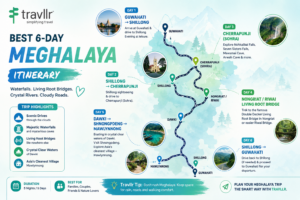
This route gives you the main highlights without trying to cover everything.
Day 1: Arrive in Guwahati and Drive to Shillong
Most Meghalaya trips start from Guwahati.
Land at Guwahati Airport or arrive at Guwahati Railway Station, then drive to Shillong.
The drive usually gives you the first taste of the North East: hills, winding roads, changing weather and green views.
Plan:
- Airport or station pickup
- Drive to Shillong
- Stop at Umiam Lake if timing works
- Hotel check-in
- Evening at Police Bazaar or café
- Early dinner
Keep Day 1 light.
Do not add too many attractions after the journey. Families usually feel tired after flights and road travel.
Travllr Tip
Stay in Shillong on Day 1 if your flight arrives late or if you travel with family. It gives you a softer start before Cherrapunji.
Day 2: Shillong Sightseeing and Drive to Cherrapunji
Start Day 2 with easy Shillong sightseeing.
You can visit:
- Ward’s Lake
- Elephant Falls
- Shillong Peak, if visibility is good
- Don Bosco Museum, if interested
- Cafés or local market
- Umiam Lake, if missed on Day 1
Then drive towards Cherrapunji, also called Sohra.
Cherrapunji feels more dramatic than Shillong. The weather changes quickly, clouds move low, and the waterfall belt begins.
Plan your stay in Cherrapunji for the next two nights if you want better access to waterfalls, caves and the living root bridge side.
Why Stay in Cherrapunji?
- You reduce back-and-forth driving.
- You get better access to waterfalls.
- You can start the Nongriat trek early.
- You experience Meghalaya’s misty side better.
- You avoid making Shillong your base for everything.
Travllr should choose the stay based on comfort, road access and food needs.
Day 3: Cherrapunji Waterfalls, Caves and Viewpoints
Day 3 gives you the classic Cherrapunji experience.
Add:
- Nohkalikai Falls
- Seven Sisters Falls / Nohsngithiang Falls
- Mawsmai Cave
- Arwah Cave, if suitable
- Mawkdok Dympep Valley Viewpoint
- Dainthlen Falls
- Wei Sawdong Falls, if access and fitness allow
Meghalaya Tourism lists Mawsmai Cave as one of the accessible Cherrapunji attractions and notes that it sits about 58 km from Shillong; Nohkalikai Falls is also near Sohra/Cherrapunji and remains one of the region’s major waterfall stops.
Do not add every waterfall in one day.
Some places need steps. Some routes get slippery. Some viewpoints depend on fog and weather.
A good Meghalaya day should feel scenic, not exhausting.
Travllr Tip
If you travel in monsoon, waterfalls look powerful, but access paths can become slippery. Keep flexible timing and avoid risky waterfall descents during heavy rain.
Day 4: Nongriat Double Decker Living Root Bridge Trek
Day 4 is the most important decision day.
You can either do the Nongriat Double Decker Living Root Bridge trek or choose an easier living root bridge experience.
The Nongriat bridge is one of Meghalaya’s most famous experiences. Meghalaya Tourism describes Nongriat as an East Khasi Hills village around 15 km from Cherrapunji/Sohra and highlights the Double Decker Living Root Bridge as a two-level bridge formed from rubber fig tree roots.
But the trek is not easy for everyone.
The Nongriat route involves many steps, steep sections and physical effort. Travellers should not treat it like a casual viewpoint stop.
Choose Nongriat If:
- You can climb stairs comfortably.
- You enjoy trekking.
- You are physically fit.
- You are okay with a long day.
- You want the iconic Double Decker bridge experience.
- You do not mind getting tired.
Skip Nongriat If:
- You travel with senior citizens.
- You have knee pain.
- You have small kids.
- You dislike long stair climbs.
- You want a relaxed holiday.
- You are travelling during heavy rain and the path feels risky.
Easier Alternative
Choose the Riwai Living Root Bridge near Mawlynnong if you want a lighter experience.
It gives you the living root bridge feel without the demanding Nongriat trek.
Travllr Verdict for Day 4
Do Nongriat only if the group can handle it.
Do not force it because Instagram made it famous.
Meghalaya has enough beauty even without the hardest trek.
Day 5: Cherrapunji to Dawki, Shnongpdeng and Mawlynnong
Day 5 takes you towards Dawki and the famous Umngot River.
This is the day many travellers wait for because Dawki photos look magical when the water is clear.
Plan:
- Breakfast
- Drive towards Dawki
- Umngot River boating, if conditions are good
- Shnongpdeng riverside time
- Mawlynnong village
- Riwai Living Root Bridge
- Drive back to Shillong or stay near Dawki/Shnongpdeng, depending on route
Meghalaya Tourism describes Dawki as a southern Meghalaya border town and says the best time to visit Dawki is generally October to May for pleasant weather and outdoor activities.
Important Dawki Note
Do not expect crystal-clear water in every season.
During heavy rain or monsoon, the river may look muddy because the water flow and silt increase. Recent travel coverage has also warned that monsoon can change Dawki’s famous clear-water appearance and may make some access routes risky around waterfall areas.
If your main goal is the floating-boat photo, choose post-monsoon or winter months.
Travllr Tip
Do not combine Nongriat trek and Dawki on the same day for families. It becomes too tiring.
Keep them separate.
Day 6: Shillong to Guwahati Departure
Keep the final day practical.
Plan:
- Breakfast
- Hotel checkout
- Drive from Shillong to Guwahati
- Airport or railway station drop
- Return journey
Do not book a very early flight from Guwahati if you are starting from Shillong that morning.
Road delays can happen because of traffic, weather or local conditions.
Travllr should keep a safe buffer for the final day.
End the trip calmly.
Best Stay Plan for 6 Days
| Night | Best Stay | Why |
|---|---|---|
| Night 1 | Shillong | Easy arrival and soft start |
| Night 2 | Cherrapunji/Sohra | Better access to waterfalls |
| Night 3 | Cherrapunji/Sohra | Useful for Nongriat or cave day |
| Night 4 | Cherrapunji or Dawki/Shnongpdeng | Depends on trek and river plan |
| Night 5 | Shillong | Easier final departure |
For families, Travllr usually keeps the final night in Shillong to make the Guwahati departure easier.
For friends and adventure travellers, Travllr can add a Shnongpdeng riverside stay if the season and comfort level work.
Meghalaya Trekking Difficulty Table
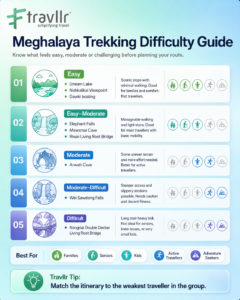
| Place / Experience | Difficulty | Best For | Travllr Advice |
|---|---|---|---|
| Umiam Lake | Easy | Families, seniors | Good arrival stop |
| Elephant Falls | Easy/moderate | Families | Some steps involved |
| Mawsmai Cave | Easy/moderate | Families, couples | Can feel narrow inside |
| Arwah Cave | Moderate | Explorers | Wear proper shoes |
| Nohkalikai Viewpoint | Easy | Everyone | Visibility depends on fog |
| Wei Sawdong Falls | Moderate/difficult | Young travellers | Access can be slippery |
| Nongriat Double Decker Bridge | Difficult | Fit travellers | Avoid with seniors/knee issues |
| Riwai Living Root Bridge | Easy/moderate | Families | Good Nongriat alternative |
| Dawki Boating | Easy | Families, couples | Best when water is clear |
| Shnongpdeng activities | Easy to adventurous | Friends, couples | Water level and season matter |
Travllr should match the itinerary to the weakest traveller in the group.
That is how the whole group enjoys the trip.
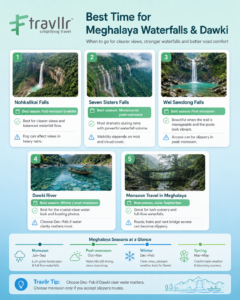
Best Time to Visit Meghalaya
Meghalaya changes completely by season.
| Season | Months | Travel Feel | Travllr Verdict |
|---|---|---|---|
| Spring | March to April | Pleasant, green, good for sightseeing | Good for families |
| Summer | May to June | Warm in plains, cooler in hills, pre-monsoon rain | Good but weather can shift |
| Monsoon | July to September | Powerful waterfalls, heavy rain, slippery routes | Beautiful but risky for some travellers |
| Post-monsoon | October to November | Clearer weather, green views, good roads | Best overall |
| Winter | December to February | Clear skies, colder evenings, good Dawki water visibility | Great for families and photography |
Meghalaya Tourism’s planning guidance says October to April works well for pleasant weather, clear skies and sightseeing, while monsoon works for lush scenery and waterfalls.
Travllr Recommendation
Choose October to April for first-time family travel.
Choose July to September only if you want monsoon waterfalls and can accept slippery paths, rain delays and river visibility changes.
Choose December to February if Dawki’s clear-water look matters to you.
 Meghalaya Trip Cost for 6 Days
A 6-day Meghalaya trip cost depends on vehicle type, hotel category, season, route and activities.
| Travel Style | Approx Cost Per Person | What to Expect |
|---|---|---|
| Budget | ₹25,000 – ₹35,000 | Basic hotels, standard vehicle, limited activities |
| Comfort | ₹40,000 – ₹60,000 | Better stays, private vehicle, planned route |
| Premium | ₹65,000 – ₹90,000+ | Boutique stays, curated route, slower pace |
| Luxury-light | ₹1 lakh+ | Premium stays where available, private experiences |
These ranges usually exclude flights unless the package says otherwise.
Cost changes by:
- Flights to Guwahati
- Hotel category
- Vehicle type
- Season
- Driver quality
- Dawki boating
- Guide charges
- Trekking support
- Riverside stay
- Meals
- Group size
- Activity inclusions
Travllr should show the full cost clearly.
A cheap Meghalaya package may exclude key activities, entry fees, guides or proper vehicle comfort.
Food in Meghalaya
Shillong has good food options.
You can find cafés, restaurants, Indian food, local food and vegetarian options.
Cherrapunji also has decent options, but choices become more limited compared to Shillong.
Dawki, Shnongpdeng and remote routes can have simpler food.
Vegetarian travellers should plan meals in advance.
Jain travellers should be extra clear before booking.
Ask Travllr:
- Can hotels provide vegetarian food?
- Can they prepare no onion and no garlic meals?
- Will breakfast work for the family?
- Will packed food be needed for Nongriat day?
- Will Dawki day have proper lunch stops?
- Should travellers carry snacks?
Good backup snacks include:
- Khakhra
- Thepla
- Dry fruits
- Makhana
- Biscuits
- Energy bars
- Tea sachets
- ORS
- Medicines
Food planning matters more on long road and trek days.
Meghalaya with Senior Citizens
Meghalaya can work well for seniors if you choose the right route.
Senior travellers usually enjoy:
- Shillong
- Umiam Lake
- Ward’s Lake
- Easy viewpoints
- Mawsmai Cave, if comfortable
- Nohkalikai viewpoint
- Dawki boating, if access is easy
- Mawlynnong village
- Light cafés and markets
They may struggle with:
- Nongriat trek
- Steep waterfall descents
- Slippery monsoon paths
- Long back-to-back road days
- Basic remote stays
- Too many packed attractions
Travllr should avoid the heavy trekking version for seniors.
Choose Riwai Living Root Bridge instead of Nongriat if comfort matters.
Meghalaya with Kids
Kids can enjoy Meghalaya a lot.
They usually like:
- Caves
- Waterfalls
- Boating
- Cloudy roads
- Open spaces
- Umiam Lake
- Village walks
- Short root bridge experiences
But kids may struggle with:
- Long drives
- Too many stairs
- Rainy days
- Wet clothes
- Slippery paths
- Late meals
- Basic washrooms on remote routes
Travllr should keep snacks, raincoats, extra clothes and shorter sightseeing days ready.
A family Meghalaya trip should feel adventurous but not tiring.
What to Pack for Meghalaya
Pack for rain, walking and changing weather.
Carry:
- Light jacket
- Raincoat or poncho
- Umbrella
- Comfortable walking shoes
- Extra socks
- Quick-dry clothes
- Small backpack
- Power bank
- Basic medicines
- Motion sickness tablets
- ORS
- Water bottle
- Sunscreen
- Mosquito repellent
- Cash
- Snacks
- Waterproof phone pouch
- Plastic pouch for wet clothes
- ID proof
For Nongriat trek, carry light luggage only.
Do not carry heavy backpacks down the steps.
Common Meghalaya Planning Mistakes
Mistake 1: Adding too much in 6 days
Do not try to cover Shillong, Cherrapunji, Dawki, Nongriat, Mawlynnong, Jowai, Krang Suri and Mawsynram in one rushed plan.
Choose what fits your group.
Mistake 2: Underestimating Nongriat
The Double Decker Living Root Bridge trek is beautiful but tiring.
Do not treat it like a quick stop.
Mistake 3: Expecting Dawki water clarity in monsoon
Dawki may not look clear during heavy rain.
Choose the right season.
Mistake 4: Booking bad stay locations
A poor location can increase driving time every day.
Mistake 5: Not keeping rain flexibility
Weather changes fast in Meghalaya.
Keep buffer time.
Mistake 6: Not planning food
Vegetarian and Jain travellers should tell Travllr before booking.
Mistake 7: Wearing wrong shoes
Waterfalls, caves and treks need proper shoes.
Avoid slippery footwear.
Mistake 8: Making every day road-heavy
Meghalaya feels best when you slow down.
Do not spend the whole trip inside a car.
Travllr Verdict
A Meghalaya itinerary 6 days works best when you balance beauty with road comfort.
For most Indian families and first-time travellers, Travllr recommends:
Guwahati → Shillong → Cherrapunji → Nongriat or Riwai Living Root Bridge → Dawki → Mawlynnong → Shillong
Do Nongriat only if the group can handle trekking.
Choose Riwai if you want an easier root bridge experience.
Choose Dawki in the right season if clear water matters.
Keep Cherrapunji for waterfalls, caves and misty landscapes.
Do not rush Meghalaya.
The destination feels better when the route has space.
FAQs
1. What is the best Meghalaya itinerary for 6 days?
The best 6-day Meghalaya itinerary covers Shillong, Cherrapunji, Nongriat or Riwai Living Root Bridge, Dawki, Shnongpdeng and Mawlynnong. Start and end the trip through Guwahati for easier flight or train access.
2. Is 6 days enough for Meghalaya?
Yes, 6 days are enough for a good first Meghalaya trip. You can cover Shillong, Cherrapunji, Dawki, Mawlynnong and one living root bridge experience without rushing too much.
3. Should I stay in Shillong or Cherrapunji?
Stay in Shillong for arrival and departure comfort. Stay in Cherrapunji for better access to waterfalls, caves and the living root bridge side. A split stay works better than using Shillong as the only base.
4. Is the Nongriat Double Decker Living Root Bridge trek difficult?
Yes, the Nongriat trek can feel difficult because it involves many steps and a long climb back. Fit travellers can do it, but seniors, small kids and people with knee issues should choose easier root bridge options like Riwai.
5. What is the best time to visit Meghalaya?
October to April works best for sightseeing, clear skies and family travel. Monsoon gives powerful waterfalls and lush views, but routes can become slippery and Dawki water may not look clear.
6. Is Dawki worth visiting?
Yes, Dawki is worth visiting when the season supports clear water and boating. October to May usually works better for Dawki outdoor activities. During heavy rain, river clarity and access can change.
7. Is Meghalaya good for family trips?
Yes, Meghalaya works very well for family trips if the itinerary stays balanced. Families should avoid very heavy trekking days and keep enough time for meals, road travel and weather changes.
8. How much does a 6-day Meghalaya trip cost?
A 6-day Meghalaya trip usually costs around ₹25,000 to ₹60,000 per person for budget-to-comfort travel, excluding flights if needed. Premium trips can cost more depending on hotels, vehicle, activities and route style.
Conclusion
Meghalaya is one of the most beautiful nature trips in India.
It gives you clouds, waterfalls, caves, rivers, clean villages and living root bridges.
But the best Meghalaya trip is not the one with the maximum places.
It is the one that matches your group.
If you travel with family, keep the route comfortable.
>If you travel with seniors, avoid the hardest treks.
>If you want Dawki photos, choose the right season.
>If you want root bridges, choose the right difficulty level.
>If you travel in monsoon, keep flexibility.
For most travellers, a 6-day route works beautifully:
Shillong → Cherrapunji → Living Root Bridge → Dawki → Mawlynnong
Travllr can help you plan the right version based on your season, budget, road comfort and trekking ability.
Leave a Reply