A Japan trip from India in 2026 usually costs around ₹1.6 lakh to ₹2.3 lakh per person for an 8-day budget-to-comfort trip. A premium family or couple trip can cost ₹2.5 lakh to ₹4 lakh+ per person, depending on flights, hotels, bullet trains, activities, food, visa, travel season and route.
For first-time Indian travellers, the best 8-day Japan route is Tokyo → Mt. Fuji / Hakone → Kyoto → Osaka.
Why Japan Feels Like a Dream Trip for Indians
Japan feels different from most international trips.
It is clean.
It is safe.
It is organised.
It has bullet trains.
It has cherry blossoms.
It has anime culture.
It has temples, gardens, neon streets, shopping, theme parks and Mount Fuji.
For Indian travellers, Japan feels exciting because it gives a mix of modern and traditional.
One day, you stand in the middle of Tokyo’s bright city lights.
The next day, you see Mount Fuji.
Then you walk through Kyoto’s old streets.
After that, you eat, shop and explore Osaka.
Japan feels premium, but it does not always need to feel impossible.
You just need to plan it carefully.
Because Japan can become expensive if you choose the wrong route, wrong hotel area, wrong train pass or wrong season.
So this guide will help you understand the real cost, visa basics, best route, best time and food planning for a Japan trip from India.
Japan Trip from India: Quick Snapshot
| Trip Detail | Recommendation |
|---|---|
| Ideal duration | 7 to 9 days |
| Best first-time route | Tokyo → Mt. Fuji / Hakone → Kyoto → Osaka |
| Best for | Couples, families, anime fans, culture lovers, premium travellers |
| Visa | Japan tourist visa required for Indian passport holders |
| Best months | March–April for cherry blossoms, October–November for autumn |
| Budget range | ₹1.6 lakh to ₹2.3 lakh per person for budget-to-comfort |
| Premium range | ₹2.5 lakh to ₹4 lakh+ per person |
| Food comfort | Moderate; vegetarian/Jain food needs planning |
| Main CTA | Get Japan itinerary from Travllr |
Japan Trip Cost from India in 2026
Japan is not the cheapest Asia trip.
Thailand, Vietnam and Bali usually cost less.
But Japan gives a very different experience.
You are paying for clean cities, strong public transport, bullet trains, unique stays, theme parks, culture and a premium travel feel.
Here is a practical budget range.
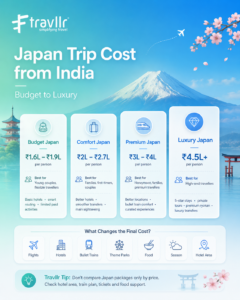
| Travel Style | Approx Cost Per Person | Best For | What to Expect |
|---|---|---|---|
| Budget Japan | ₹1.6 lakh – ₹1.9 lakh | Young couples, flexible travellers | Basic hotels, smart routing, limited paid activities |
| Comfort Japan | ₹2 lakh – ₹2.7 lakh | Families, first-timers, couples | Better hotels, smoother transfers, main sightseeing |
| Premium Japan | ₹3 lakh – ₹4 lakh | Honeymoon, families, premium travellers | Better locations, bullet train comfort, curated experiences |
| Luxury Japan | ₹4.5 lakh+ | High-end travellers | 5-star stays, private tours, premium ryokan, luxury transfers |
These are planning ranges.
Actual cost changes by departure city, travel month, airline, hotel area, train choices, theme park tickets, food preference and package inclusions.
Japan Cost Breakdown from India
Here is a practical 8-day Japan budget breakup.
| Cost Head | Budget Range Per Person | Comfort Range Per Person | Premium Range Per Person |
|---|---|---|---|
| Flights from India | ₹45,000 – ₹75,000 | ₹65,000 – ₹95,000 | ₹1 lakh+ |
| Visa + documents | ₹3,000 – ₹10,000 | ₹3,000 – ₹10,000 | ₹3,000 – ₹10,000 |
| Hotels | ₹45,000 – ₹75,000 | ₹80,000 – ₹1.4 lakh | ₹1.8 lakh+ |
| Internal transport | ₹25,000 – ₹60,000 | ₹50,000 – ₹90,000 | ₹1 lakh+ |
| Activities | ₹25,000 – ₹60,000 | ₹50,000 – ₹90,000 | ₹1.2 lakh+ |
| Food | ₹20,000 – ₹45,000 | ₹40,000 – ₹70,000 | ₹80,000+ |
| Local transport | ₹10,000 – ₹25,000 | ₹20,000 – ₹40,000 | ₹45,000+ |
| Shopping / buffer | Optional | Optional | Optional |
Travllr tip: Do not judge Japan only by package price. Check hotel area, train plan, theme park tickets, airport transfers and food support before you compare quotes.
What Makes Japan Expensive?
Japan costs more when you add these things:
- Cherry blossom season travel
- Autumn foliage season travel
- Tokyo city-centre hotels
- Kyoto traditional stays
- Bullet train journeys
- Universal Studios Japan
- Disneyland or DisneySea
- Private Mt. Fuji tours
- Premium ryokan stays
- Large family rooms
- Vegetarian/Jain food planning
- Last-minute flights
- Better hotel locations
A Japan package may look affordable at first. But if it excludes bullet train tickets, theme park tickets, airport transfers or city transport, the final cost can rise quickly.
Ask for the full breakup.
Flights from India to Japan
Indian travellers usually fly into Tokyo or Osaka.
Popular airport options include:
- Tokyo Narita
- Tokyo Haneda
- Osaka Kansai
- Nagoya Chubu, depending on route
Flights may connect through:
- Singapore
- Kuala Lumpur
- Bangkok
- Hong Kong
- Doha
- Dubai
- Vietnam or other Asian hubs
Approx Flight Cost from India
| Departure City | Approx Return Flight Cost |
|---|---|
| Delhi | ₹45,000 – ₹85,000 |
| Mumbai | ₹50,000 – ₹90,000 |
| Bengaluru | ₹50,000 – ₹95,000 |
| Chennai | ₹50,000 – ₹95,000 |
| Hyderabad | ₹55,000 – ₹1 lakh |
| Ahmedabad | ₹60,000 – ₹1.1 lakh |
These are planning ranges.
Travllr should check:
- Layover time
- Baggage allowance
- Arrival airport
- Return airport
- Meal preference
- Refund rules
- Connection risk
- Total travel time
For an 8-day Japan trip, open-jaw flights can work well.
For example:
Fly into Tokyo.
Fly out of Osaka.
This saves backtracking.
Japan Visa for Indians in 2026
Indian passport holders generally need a Japan tourist visa before travel.
Travllr should check the latest rules before every booking because visa processes and fees can change.
A Japan visa file usually needs:
- Passport
- Visa application form
- Photo
- Flight itinerary
- Hotel bookings
- Day-wise itinerary
- Bank statements
- ITR or financial documents
- Employment proof or business proof
- Leave letter or NOC
- Cover letter
- Sponsor documents, if someone else pays
- Travel history, if available
Japan visa planning is not as complex as Schengen, but travellers should still prepare clean documents.
Do not submit a confusing route.
Your visa documents should match your actual travel plan.
Japan Visa Tips for Indian Families
Families should prepare documents early.
Check:
- Passport validity for every traveller
- Child documents
- School leave letter, if needed
- Sponsorship documents
- Bank statements
- Employment documents
- Family relationship proof where relevant
- Hotel names and dates
- Correct entry and exit cities
Do not wait until the last moment.
Japan trips often involve higher flight and hotel costs, so visa clarity matters before final payment deadlines.
Travllr should guide travellers on documents before booking non-refundable services.
Best Time to Visit Japan from India
Japan changes beautifully by season.
Your best time depends on what you want.
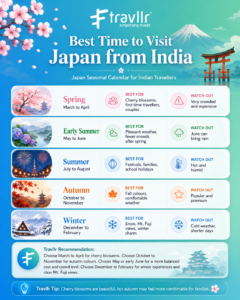
| Season | Months | Best For | Watch Out For |
|---|---|---|---|
| Spring | March to April | Cherry blossoms, first-time travellers, couples | Very crowded and expensive |
| Early summer | May to June | Pleasant weather, fewer crowds after spring | June can bring rain |
| Summer | July to August | Festivals, families, school holidays | Hot and humid |
| Autumn | October to November | Fall colours, comfortable weather | Popular and premium |
| Winter | December to February | Snow, Mt. Fuji views, winter charm | Cold weather, shorter days |
Travllr recommendation:
Choose March to April if cherry blossoms matter.
Choose October to November if you want beautiful weather and autumn colours.
Choose May or early June if you want a more balanced cost and crowd level.
Choose December to February if you want winter experiences and clear Mt. Fuji views.
Cherry Blossom Season: Is It Worth It?
Yes, cherry blossom season feels special.
Tokyo, Kyoto and Osaka look beautiful in spring.
But cherry blossom season also brings:
- Higher hotel prices
- More crowds
- Expensive flights
- Peak demand
- Limited room availability
- More pressure to book early
If you want cherry blossoms, start planning 5 to 6 months in advance.
Do not expect last-minute deals.
Also remember: sakura bloom depends on weather.
You can plan the best dates, but nature decides the exact bloom.
Travllr should build some flexibility into the route.
Autumn in Japan: A Strong Alternative
Autumn is one of the best times to visit Japan.
The weather feels comfortable.
The colours look beautiful.
Kyoto feels magical.
Tokyo feels easier than peak sakura season.
Families enjoy sightseeing more because the weather feels pleasant.
October and November work very well for Indian families and couples.
If you do not want the pressure of cherry blossom season, choose autumn.
Travllr recommendation: For most Indian families, autumn may feel more comfortable than peak spring.
Best 8-Day Japan Itinerary from India
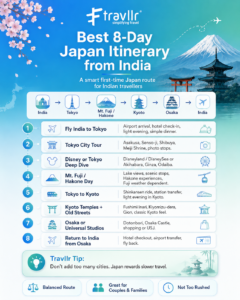
For first-time Indian travellers, Travllr recommends this route:
Tokyo → Mt. Fuji / Hakone → Kyoto → Osaka
This route works because it gives you the full first-time Japan experience.
Tokyo gives modern Japan.
Mt. Fuji gives the iconic scenic moment.
Kyoto gives culture and temples.
Osaka gives food, shopping and theme park energy.
Do not add too many cities in 8 days.
Japan rewards slower travel.
8-Day Japan Itinerary from India
Day 1: Fly from India to Tokyo
Start your Japan trip with a flight to Tokyo.
Keep the first day light.
A good Day 1 plan includes:
- Airport pickup or train transfer
- Hotel check-in
- Light evening walk
- Simple dinner
- Early rest
Travllr should choose the arrival airport and hotel area carefully.
Tokyo is huge.
A cheaper hotel far from the main areas can waste a lot of time.
Day 2: Tokyo City Tour
Use Day 2 to understand Tokyo.
Add a balanced mix of modern and traditional places.
You can visit:
- Asakusa
- Senso-ji Temple
- Tokyo Skytree photo stop or visit
- Shibuya Crossing
- Harajuku
- Meiji Shrine
- Ginza or Akihabara, depending on interest
Do not add too much in one day.
Tokyo has many attractions, but travel time between areas can add up.
Travllr should group attractions by area.
That saves time and energy.
Day 3: Tokyo DisneySea / Disneyland or City Deep Dive
Day 3 depends on your traveller type.
Choose DisneySea or Disneyland if:
- You travel with kids.
- You love theme parks.
- You want a full-day experience.
- You are okay with crowds.
- You can book tickets early.
Choose Tokyo city deep dive if:
You do not want theme parks.
You want shopping.
You like anime.
You want cafés and local streets.
You prefer a slower day.
Good alternatives include:
- Akihabara
- TeamLab-style digital art experiences
- Odaiba
- Ginza shopping
- Shinjuku evening
- Ueno Park
- Tokyo Tower
For families, theme parks can make the trip exciting.
For couples, a slower Tokyo day may feel better.
Day 4: Mt. Fuji / Hakone Day Trip
This is one of the most important days of the Japan trip.
Most Indian travellers want a Mount Fuji moment.
A good plan may include:
- Mt. Fuji 5th Station, if weather allows
- Lake Kawaguchi
- Hakone
- Owakudani
- Ropeway experience
- Lake Ashi cruise
- Scenic viewpoints
- Weather matters.
Mt. Fuji may hide behind clouds.
Do not promise guaranteed views.
Travllr should explain this clearly.
If Mount Fuji stays hidden, the day can still feel beautiful if the route includes lakes, scenic drives and Hakone experiences.
Day 5: Tokyo to Kyoto by Bullet Train
Now the trip moves from modern Japan to traditional Japan.
Take the Shinkansen from Tokyo to Kyoto.
This is a major Japan experience.
Travllr should check:
- Train timing
- Seat reservation
- Luggage rules
- Station transfers
- Hotel distance from Kyoto station
- Meal planning
- Check-in timing
Do not waste this day.
After arrival, keep the evening light.
You can enjoy:
- Gion area
- Pontocho alley
- Kyoto station area
- Simple dinner
- Early rest
Kyoto feels best when you do not rush it.
Day 6: Kyoto Temples and Old Streets
Kyoto gives the classic Japan feeling.
Plan:
- Fushimi Inari Shrine
- Kiyomizu-dera Temple
- Ninenzaka and Sannenzaka streets
- Gion
- Arashiyama Bamboo Grove, if time allows
- Traditional shopping streets
- Tea experience, if interested
Kyoto involves walking.
Travllr should keep senior travellers and families in mind.
Do not put every Kyoto attraction into one day.
Choose what matters.
For vegetarian and Jain travellers, Kyoto food planning needs care.
Do not leave lunch and dinner to chance.
Day 7: Osaka Day Trip or Universal Studios Japan
Use Day 7 for Osaka.
You can choose between sightseeing and theme park.
Option A: Osaka City Day
Visit:
- Osaka Castle
- Dotonbori
- Shinsaibashi
- Namba
- Umeda area
- Shopping streets
This works well for families, friends and shopping lovers.
Option B: Universal Studios Japan
Choose this if:
- You love theme parks.
- You travel with kids or young adults.
- You want the Super Nintendo / movie experience.
- You are okay with a full-day park schedule.
Universal Studios Japan can increase the trip cost, but many families love it.
Book tickets early.
Travllr should explain the cost clearly before finalising the package.
Day 8: Return to India from Osaka
Fly back from Osaka if possible.
This avoids going back to Tokyo.
A good final day includes:
- Breakfast
- Hotel checkout
- Airport transfer
- Return flight to India
Do not add heavy sightseeing before the flight.
Japan airports and train transfers need proper timing.
End the trip calmly.
Should You Buy a Japan Rail Pass?
Many Indian travellers ask this question.
The answer depends on your route.
A nationwide JR Pass may help if your route includes multiple long-distance bullet train journeys.
But for a simple 8-day route like Tokyo → Kyoto → Osaka, point-to-point tickets may work better.
Travllr should compare both before recommending.
| Travel Plan | JR Pass Needed? | Travllr Verdict |
|---|---|---|
| Tokyo only | No | Use local transport cards |
| Tokyo + Mt. Fuji + Kyoto + Osaka | Maybe not | Compare point-to-point tickets |
| Tokyo + Kyoto + Osaka + Hiroshima | Maybe | JR Pass may make more sense |
| Multi-city long route | Yes, possibly | Check total train cost |
| Luxury/private trip | Not always | Private transfers may suit better |
Do not buy a JR Pass only because everyone says so.
Ask Travllr to calculate.
Japan Hotel Area Guide
Hotel area matters a lot in Japan.
Rooms can be smaller than Indian travellers expect. Location can change your whole trip.
| City | Good Stay Areas | Why |
|---|---|---|
| Tokyo | Shinjuku, Shibuya, Ginza, Ueno, Tokyo Station area | Better transport access |
| Kyoto | Kyoto Station, Gion, Kawaramachi | Easy sightseeing and food access |
| Osaka | Namba, Umeda, Shinsaibashi | Shopping, food, transport |
| Hakone | Ryokan areas near transport routes | Scenic stay, onsen experience |
Travllr tip: Do not choose hotels only by star rating.
Choose by station access, room size, food access and route comfort.
Vegetarian and Jain Food in Japan
Japan needs careful food planning for Indian vegetarian and Jain travellers.
Vegetarian food exists, but local dishes may use:
- Fish stock
- Dashi
- Egg
- Seafood broth
- Meat-based sauces
- Gelatin
- Shared cooking surfaces
Even a dish that looks vegetarian may include fish stock.
So Indian travellers should be careful.
Travllr should check:
- Vegetarian restaurants near hotels
- Indian restaurants in Tokyo, Kyoto and Osaka
- Theme park food options
- Breakfast suitability
- Mt. Fuji day food
- Train-day snacks
- Jain food availability
- Food cards in Japanese
- Backup snacks from India
For strict Jain travellers, Japan can work, but Travllr must plan carefully.
Do not assume food will be easy.
Food Card for Japan
Carry a clear food card.
For vegetarian travellers:
“We are vegetarian. We do not eat meat, seafood, fish stock, chicken stock, beef stock, pork, egg or gelatin. Please suggest food prepared without these ingredients.”
For Jain travellers:
“We follow a Jain vegetarian diet. We do not eat meat, seafood, eggs, onion, garlic, root vegetables, fish stock, meat stock or gelatin. Please suggest food prepared without these ingredients.”
Travllr can prepare this in English and Japanese before travel.
This helps in restaurants, hotels and cafés.
Japan Food Tips for Indian Families
Carry simple snacks.
Good options include:
- Khakhra
- Thepla
- Dry fruits
- Roasted makhana
- Energy bars
- Biscuits
- Tea sachets
- Ready-to-eat permitted snacks
- ORS
- Digestive tablets
Check airline and Japan entry rules before carrying food.
Avoid fresh fruits, loose homemade liquids and restricted items.
Families with kids and seniors should keep food backup during long travel days.
Best Japan Experiences for Indian Travellers
Japan has too many things to do.
Do not add everything.
Choose based on your traveller type.
| Experience | Best For |
|---|---|
| Shibuya Crossing | First-time Tokyo travellers |
| Senso-ji Temple | Culture and photos |
| Tokyo DisneySea / Disneyland | Families and kids |
| Akihabara | Anime and gaming fans |
| Mt. Fuji / Hakone | Scenic travellers |
| Shinkansen ride | Everyone |
| Fushimi Inari | Kyoto culture lovers |
| Arashiyama | Nature and photo lovers |
| Osaka Castle | Families and history lovers |
| Dotonbori | Food, shopping and city vibes |
| Universal Studios Japan | Families, friends, young travellers |
Travllr should not overload the itinerary.
A good Japan trip balances city, culture, theme parks and rest.
Who Should Choose Japan?
Choose Japan if:
- You want a premium Asia trip.
- You enjoy clean cities.
- You like culture and technology.
- You want cherry blossoms or autumn colours.
- You want a safe family trip.
- You love anime, shopping or theme parks.
- You want bullet train experiences.
- You can plan food carefully.
- You have at least 7 to 8 days.
Japan suits couples, families, young travellers, premium travellers and culture lovers.
Who Should Skip Japan?
Japan may not suit you if:
- You want a very cheap international trip.
- You need very easy Jain food without planning.
- You dislike walking.
- You want a relaxed beach holiday.
- You have only 4 to 5 days.
- You are booking last minute during cherry blossom season.
- You want large hotel rooms at low prices.
- You do not want to use public transport.
Travllr may suggest Thailand, Vietnam, Bali, Dubai or Singapore if those fit your budget and food needs better.
Common Japan Planning Mistakes Indians Make
Mistake 1: Adding too many cities
Japan looks easy on a map, but city transfers take time.
Keep the route clean.
Mistake 2: Buying JR Pass without checking
Calculate point-to-point tickets first.
A JR Pass does not always save money.
Mistake 3: Booking hotels far from stations
Japan works best when you stay near good transport.
Mistake 4: Underestimating food challenges
Vegetarian and Jain food need planning.
Do not leave it for later.
Mistake 5: Choosing cherry blossom season too late
Book early for spring.
Hotels and flights can become expensive.
Mistake 6: Ignoring walking levels
Tokyo, Kyoto and Osaka involve walking.
Plan seniors’ comfort.
Mistake 7: Packing heavy luggage
Japan’s trains and hotel rooms work better with lighter luggage.
Mistake 8: Not checking theme park tickets early
Disney and Universal can get expensive or limited.
Book early.
Travllr Verdict
A Japan trip from India works best when you keep the route simple and practical.
For first-time travellers, Travllr recommends:
Tokyo → Mt. Fuji / Hakone → Kyoto → Osaka
This 8-day route gives you modern Japan, Mount Fuji, temples, old streets, bullet train experience, shopping and theme park options.
Japan is not the cheapest Asia trip, but it gives high value when you plan it well.
- Check flights.
- Check visa documents.
- Check hotel areas.
- Check train costs.
- Check theme park tickets.
- Check vegetarian food.
- Check the season.
Do not plan Japan like Thailand or Bali.
Japan needs sharper planning.
Travllr can help you build the right route, cost and food plan before you book.
FAQs
1. How much does a Japan trip from India cost in 2026?
A Japan trip from India in 2026 usually costs around ₹1.6 lakh to ₹2.3 lakh per person for an 8-day budget-to-comfort trip. Premium trips with better hotels, bullet trains, theme parks and private tours can cost ₹2.5 lakh to ₹4 lakh+ per person.
2. How many days are enough for Japan from India?
Eight days work well for a first Japan trip from India. You can cover Tokyo, Mt. Fuji or Hakone, Kyoto and Osaka without making the route too rushed.
3. What is the best Japan itinerary for first-time Indian travellers?
The best first-time Japan itinerary is Tokyo, Mt. Fuji or Hakone, Kyoto and Osaka. This route gives you city life, scenic views, temples, bullet train experience, shopping and theme park options.
4. Do Indians need a visa for Japan?
Yes, Indian passport holders generally need a Japan tourist visa before travel. Travellers should check the latest visa rules, fees and document requirements before booking flights and hotels.
5. Is Japan good for Indian families?
Yes, Japan works well for Indian families because it feels clean, safe, organised and full of unique experiences. Families should plan hotels, food, walking levels, trains and theme park tickets carefully.
6. Is vegetarian food available in Japan?
Vegetarian food is available in Japan, but Indian vegetarian travellers should plan carefully. Many Japanese dishes may contain fish stock, egg, seafood broth or gelatin. Carry a food card and pre-check restaurants.
7. Should I buy a Japan Rail Pass?
Buy a Japan Rail Pass only if your route includes enough long-distance train journeys to justify the cost. For a simple Tokyo-Kyoto-Osaka route, point-to-point tickets may work better. Ask Travllr to compare before buying.
8. What is the best time to visit Japan from India?
March to April works best for cherry blossoms, while October to November works best for autumn colours. May and early June can also work well for travellers who want fewer crowds and better value.
Conclusion
Japan is one of the most exciting trips Indian travellers can take.
It gives you Tokyo’s lights, Mount Fuji’s views, Kyoto’s temples, Osaka’s energy and a travel experience that feels completely different from other Asian destinations.
But Japan needs smart planning.
- Do not overpack cities.
- Do not ignore hotel location.
- Do not buy train passes blindly.
- Do not leave vegetarian food to chance.
- Do not book cherry blossom season late.
For a first-time Japan trip from India, Travllr recommends an 8-day route:
Tokyo → Mt. Fuji / Hakone → Kyoto → Osaka
This route gives you the best first Japan experience without making the trip too tiring.
Get Japan itinerary from Travllr with cost breakdown, visa guidance, hotels, trains, sightseeing, food tips and the best route for your family or couple trip.
Leave a Reply