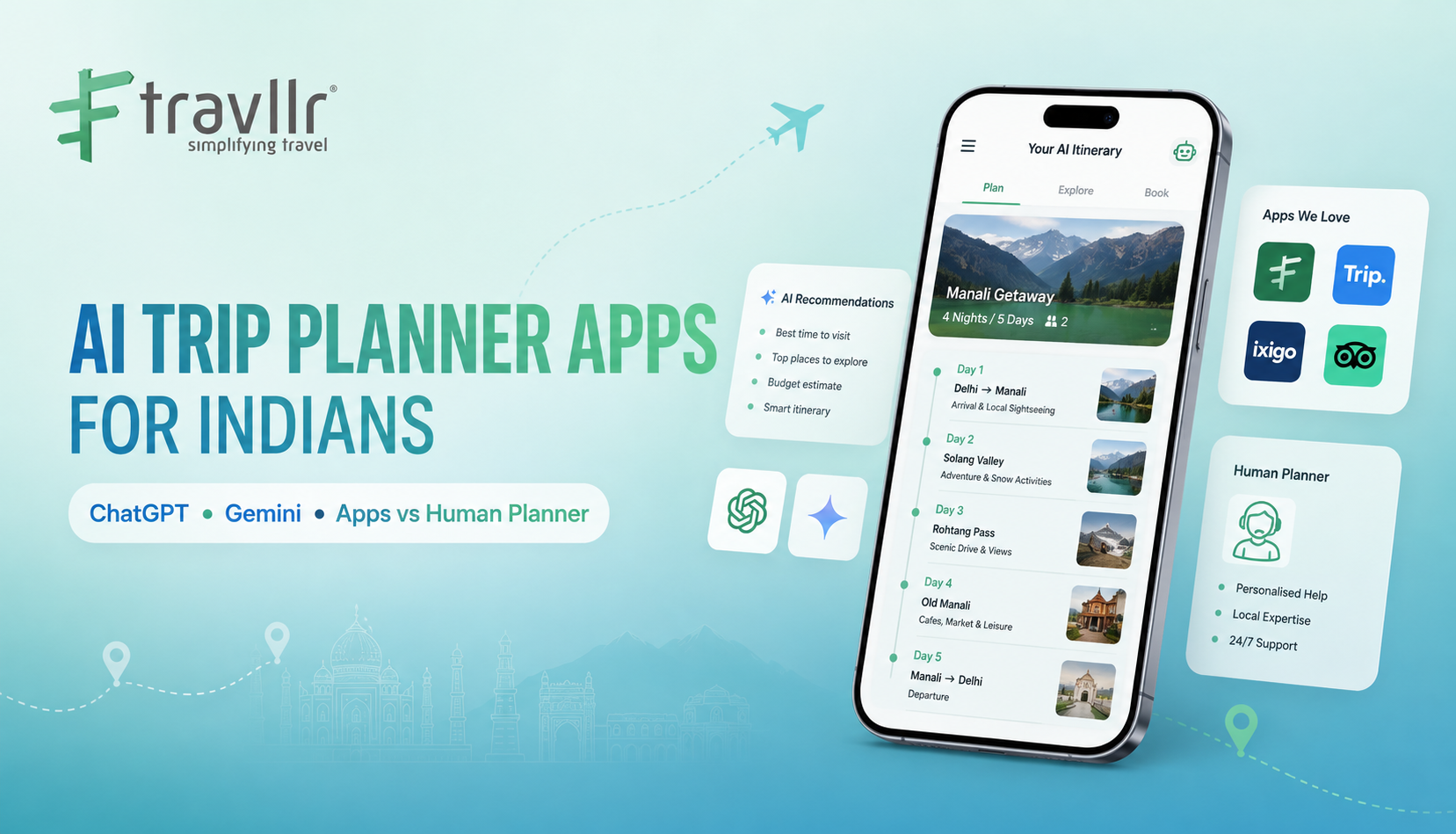
The best AI trip planner apps for Indians are ChatGPT, Gemini, Wanderlog, TripIt, Google Maps, Google Flights, MakeMyTrip-style travel assistants and human travel planners like Travllr.
- Use ChatGPT when you want ideas, day-wise itineraries, budget planning, packing lists, food notes and comparison help. OpenAI says ChatGPT can help with everyday tasks like brainstorming, writing, planning, analyzing files and searching the web, depending on the plan and settings.
- Use Gemini when you want Google-connected travel planning. Gemini can help find places and directions through Maps, and it can also search for flights and hotels in Gemini Apps.
- Use Wanderlog when you want a map-based itinerary, group collaboration, budgets, reservations and shared planning. Wanderlog says it helps travellers create trip itineraries, organize flight and hotel reservations, view places on a map and collaborate with friends.
- Use TripIt when you already have bookings and want one clean itinerary. TripIt says travellers can forward flight, hotel, rental car and other travel confirmations to its email address, and the app adds them to a full itinerary.
- Use a human planner when the trip involves visas, seniors, kids, Jain food, multiple cities, refunds, weather risk, group coordination or high-value bookings.
AI can suggest a trip.
A human planner can protect the trip.
That is the real difference.
First, What Is an AI Trip Planner?
An AI trip planner is a tool that helps you plan a trip using artificial intelligence.
You can ask it questions like:
- “Plan a 6-day Vietnam trip under ₹1 lakh.”
- “Make a Japan itinerary for vegetarian travellers.”
- “Compare Bali and Thailand for honeymoon.”
- “Create a Kashmir route for parents.”
- “Tell me what to pack for Ladakh.”
- “Find hotels near Marina Bay for Singapore F1.”
- “Make this itinerary less tiring for senior citizens.”
The tool then gives you ideas, routes, day-wise plans, checklists or comparisons.
That sounds useful.
And it is.
But here is the honest part:
AI is good at planning direction.
AI is not always good at final confirmation.
It can help you think.
It can help you compare.
It can help you organize.
However, it may miss live prices, permit changes, hotel policies, visa rules, road conditions, festival ticket availability, food reality and local supplier issues.
So the smartest traveller should not ask:
“Can AI plan my whole trip?”
The better question is:
“Which part of my trip should AI plan, and which part should a human verify?”
That is the real travel planning answer for Indian travellers.
AI Trip Planner Apps for Indians: Quick Comparison
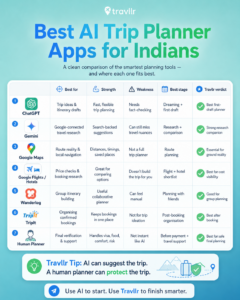
| Tool | Best For | Weakness | Travllr Verdict |
|---|---|---|---|
| ChatGPT | Ideas, itineraries, comparisons, budget planning, packing, food notes | Needs verification for live rules and prices | Best thinking assistant |
| Gemini | Google-connected planning, Maps, flights, hotels, Gmail/Calendar context | Feature access can vary by device, region and account | Best Google ecosystem assistant |
| Google Maps | Places, routes, reviews, distances, saved lists | Not a full trip planner by itself | Best on-ground navigation tool |
| Google Flights / Hotels | Flight and hotel search | Not a complete itinerary planner | Best price-checking support |
| Wanderlog | Collaborative itinerary, maps, reservations, budgeting | Needs manual checking for real availability | Best group planning app |
| TripIt | Organizing confirmed bookings | Better after booking than before booking | Best booking organizer |
| MakeMyTrip / OTA assistants | Search, booking and package discovery | May push platform inventory | Useful for booking-led planning |
| Human Planner | Visas, family comfort, Jain food, supplier checks, payments, emergencies | Not instant like AI | Best final decision partner |
Travllr’s Simple Recommendation
Use ChatGPT for the first draft.
Use Gemini for Google-connected planning.
Use Google Maps for route reality.
Use Google Flights and hotel tools for pricing checks.
Use Wanderlog for group planning.
Use TripIt after bookings are done.
Use Travllr or a human planner before paying.
That is the safest workflow.
AI can help you dream.
But before you spend real money, let a human check the plan.
Why Indians Need a Different Kind of Trip Planner
Indian travellers do not plan trips the same way everyone else does.
Most Indian trips need more checks.
We care about:
- Visa rules
- Budget clarity
- Flight timing
- Hotel area
- Food comfort
- Vegetarian food
- Jain food
- Senior comfort
- Kid-friendly routes
- Family room needs
- Group travel
- Shopping time
- Indian restaurants
- Weather
- Festival dates
- Refunds
- Payment support
- Transfers
- Driver quality
- Local contact
- Travel insurance
- Safety
- Documents
A normal AI tool may give a beautiful route.
But it may not know that your parents cannot do three hotel changes in five days.
It may not know that “vegetarian” in Japan can still contain fish stock.
It may not know that a cheap Bali villa may sit far from Indian food.
It may not know that your Dubai package looks cheap because Burj Khalifa tickets are not included.
It may not know that a Ladakh itinerary should not rush to Pangong on Day 1.
That is why AI should support planning.
It should not replace judgment.
1. ChatGPT as an AI Trip Planner
ChatGPT is one of the best tools for early-stage travel planning.
You can use it to:
- Choose destinations
- Compare countries
- Create itineraries
- Estimate budgets
- Check pros and cons
- Plan food
- Create packing lists
- Simplify visa checklists
- Rewrite travel plans
- Make family-friendly routes
- Create honeymoon plans
- Compare hotels by area
- Convert messy notes into clean itineraries
OpenAI’s Help Center says ChatGPT can help with planning and can also analyze files and images on supported plans. It also notes that ChatGPT can search the web, depending on availability and settings.
This makes ChatGPT useful for Indian travellers who want a clean starting point.
For example, you can ask:
“Plan a 7-day Japan trip for an Indian vegetarian family with two senior citizens.”
Or:
“Compare Sri Lanka, Vietnam and Thailand for a trip under ₹1 lakh from Chennai.”
ChatGPT can quickly create a direction.
Then you can take that draft to Travllr for real pricing, hotels, flights and visa checks.
Best Uses for ChatGPT
- Destination comparison
- Budget planning
- Day-wise itinerary drafts
- Packing lists
- Food planning
- Visa document checklist
- Senior-friendly route changes
- Kids’ travel planning
- Honeymoon ideas
- SEO travel research
- Blog-style travel content
Where ChatGPT Needs Verification
- Flight fares
- Hotel availability
- Visa rule changes
- Permit rules
- Ticket availability
- Weather warnings
- Road conditions
- Supplier quality
- Festival passes
- Cancellation rules
- Exact opening hours
Travllr Verdict
ChatGPT is the best first-draft travel planner.
But do not book only from a ChatGPT itinerary.
Use it to think faster.
Then verify everything before payment.
2. Gemini as an AI Trip Planner
Gemini works well for travellers who already use Google products.
It can help with:
- Places
- Maps
- Directions
- Flights
- Hotels
- Gmail context
- Calendar context
- Restaurant ideas
- Local exploration
- Trip questions
Google’s Gemini Help says you can ask Gemini to find flight and hotel information. It also says Gemini can help find places and get directions with Maps in Gemini Apps.
This makes Gemini strong for practical planning.
For example, you can ask:
“Find hotels in Kuala Lumpur near Indian restaurants.”
Or:
“Plan a 4-day Singapore trip with places saved on Google Maps.”
Google also announced personal intelligence features for Gemini in India, including examples where Gemini can use context from apps like Gmail, Calendar and Photos with user permission.
That can help travellers who already have flight confirmations, hotel emails or saved screenshots.
Best Uses for Gemini
- Google Maps-based planning
- Flight and hotel search support
- Directions
- Restaurant discovery
- Gmail-based trip context
- Calendar-based planning
- Quick place research
- Local movement planning
Where Gemini Needs Verification
- Final booking price
- Hotel quality
- Hidden fees
- Visa rules
- Supplier reliability
- Food restrictions
- Refund rules
- Package inclusions
Travllr Verdict
Gemini is best for travellers who live inside Google.
It is strong for maps, places, flights and practical movement.
However, it still needs human checks before final booking.
3. Google Maps for Trip Planning
Google Maps is not a full AI trip planner.
But it is one of the most important tools in travel planning.
It helps you check:
- Hotel location
- Distance between places
- Traffic
- Restaurant options
- Reviews
- Photos
- Opening hours
- Nearby attractions
- Walking routes
- Public transport
- Saved lists
Google has also brought Gemini-powered features into Maps in India, including conversational help for asking about places. Google’s India blog says Maps can now help users ask questions about places and get helpful information instantly.
For Indian travellers, this is very useful.
Because hotel location matters more than hotel photos.
A hotel may look beautiful.
But if it sits far from food, metro, beach, attractions or transfers, the trip becomes tiring.
Best Uses for Google Maps
- Hotel area checking
- Restaurant planning
- Driving time checks
- Walking comfort
- Nearby Indian food
- Saved sightseeing lists
- Day-wise route logic
- On-ground navigation
- Where Google Maps Is Not Enough
It cannot fully judge your travel style.
It may not know that seniors need less walking.
It may not know that your family needs Jain food.
It may not know that a destination should be avoided in the wrong season.
Travllr Verdict
Google Maps is the best reality check tool.
Before booking any hotel, open the map.
That one habit can save the whole trip.
4. Google Flights and Hotel Tools
Google Flights and hotel tools are useful for price discovery.
They help travellers compare:
- Flight routes
- Airlines
- Layovers
- Dates
- Fare changes
- Hotel areas
- Basic hotel pricing
- Location options
Gemini can connect with Google Flights and Google Hotels for flight and hotel information inside Gemini Apps. However, Google’s help page also notes that some actions are not supported inside Gemini when it connects to Flights or Hotels, so travellers should still review final booking details carefully.
Best Uses
- Flight research
- Flexible-date planning
- Hotel area comparison
- Rough budget check
- Airport route decisions
- City pair planning
Where They Are Not Enough
They do not create a full travel experience.
They do not always solve:
- Visa comfort
- Food planning
- Tour transfers
- Family pacing
- Local supplier quality
- Refund complexity
- Group coordination
Travllr Verdict
Use Google tools to understand the market.
Then ask Travllr to build the actual package.
5. Wanderlog as a Trip Planner App
Wanderlog is useful when you want to visually organize a trip.
It works well for:
- Group trips
- Road trips
- Map-based planning
- Day-wise itinerary building
- Budget tracking
- Expense splitting
- Reservation organization
- Collaborative planning
Wanderlog says travellers can create itineraries, organize flight and hotel reservations, view places on a map, collaborate with friends, track budgets and split costs for group trips.
This makes it useful for friends planning trips together.
For example, if four people are planning Bali, everyone can add cafés, beaches and temples in one place.
Then the group can see the route on a map.
That is much better than 83 WhatsApp messages.
Best Uses
- Friends trips
- Group planning
- Map-based itineraries
- Budget tracking
- Expense splitting
- Road trip planning
- Restaurant and attraction lists
Where Wanderlog Needs Support
- Visa checks
- Package pricing
- Refunds
- Hotel supplier reliability
- Private transfers
- Food restrictions
- Local emergency support
Travllr Verdict
Wanderlog is great for organizing a plan.
But it does not replace a travel planner who handles real bookings and on-ground support.
6. TripIt as a Travel Organizer
TripIt is useful after you book your trip.
It helps organize confirmed plans in one place.
TripIt says travellers can forward booking confirmations like flights, hotels and rental cars to [email protected], and the app automatically adds them to a full itinerary.
This works well for travellers who book multiple things separately.
For example:
- Flight from Chennai to Singapore.
- Hotel booking.
- Universal Studios ticket.
- Airport transfer.
- Travel insurance.
- Return flight.
Instead of searching emails again and again, TripIt keeps the plan cleaner.
Best Uses
- Post-booking organization
- Flight details
- Hotel confirmations
- Rental car details
- Document storage
- Itinerary sharing
- Frequent travellers
Where TripIt Is Not Enough
It does not choose the destination for you.
It does not know if your route is too tiring.
It does not automatically solve Jain food, senior comfort, visas or local tour quality.
Travllr Verdict
TripIt is best after booking.
Use it to organize the trip.
Do not use it as your main decision-maker.
7. MakeMyTrip, OTAs and AI Booking Assistants
Online travel agencies can help with:
- Flights
- Hotels
- Packages
- Reviews
- Deals
- Booking comparison
- Payment options
- Trip discovery
Many travel companies now use AI assistants to improve search and booking. Recent reporting also says MakeMyTrip has used its AI assistant as part of its growth strategy, showing how Indian travel platforms are moving towards AI-led booking help.
These tools can be useful when the traveller already knows what they want.
For example:
“I want a 4N/5D Dubai package.”
“I want flights from Chennai to Kuala Lumpur.”
“I want a hotel in Phuket.”
However, booking platforms may still push available inventory.
So travellers should compare inclusions carefully.
Best Uses
- Flight booking
- Hotel booking
- Package discovery
- Offer comparison
- Simple holidays
- Short city breaks
Where OTAs Need Caution
- Hidden exclusions
- Transfer quality
- Hotel area
- Meal plan
- Visa support
- Cancellation terms
- On-ground emergency support
- Customized family comfort
Travllr Verdict
OTAs help you book.
Travllr helps you choose correctly.
That difference matters.
8. Human Travel Planners
A human planner is still important.
Especially for Indian travellers.
A good travel planner can ask questions that AI may miss.
For example:
- Are your parents travelling?
- Do they walk comfortably?
- Do you need Jain food?
- Do you want private transfers?
- Do you want shopping time?
- Do you want a slow honeymoon or active itinerary?
- Do you have a valid visa?
- Is the child below 2 years?
- Do you need wheelchair support?
- Is the hotel area safe at night?
- Does the driver understand the route?
- Is the package actually cheaper or just incomplete?
This is where human planning becomes valuable.
AI creates options.
Humans check reality.
Best Uses
- Visa planning
- Family holidays
- Senior citizen trips
- Jain food planning
- Group tours
- Honeymoons
- Luxury trips
- Event travel
- F1 / Tomorrowland / sports packages
- Multi-city routes
- Refund and cancellation planning
- Supplier negotiation
- Emergency support
Where Human Planners Are Better Than AI
- Live supplier checks
- Final pricing
- Hotel quality
- Local driver reliability
- Permit rules
- Visa document review
- Refund handling
- Food coordination
- Private transfers
- Special requests
- On-ground support
Travllr Verdict
Use AI for speed.
Use humans for safety.
That is the best combination.
AI vs Human Travel Planner: Honest Comparison
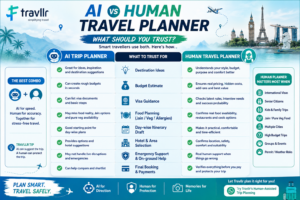
| Planning Need | AI Planner | Human Planner |
|---|---|---|
| Destination ideas | Excellent | Good |
| Itinerary draft | Excellent | Excellent |
| Budget estimate | Good | Better with live pricing |
| Visa rules | Needs verification | Stronger |
| Flight booking | Limited / linked tools | Stronger |
| Hotel area judgment | Good with maps | Better with experience |
| Jain food | Basic help | Much better |
| Senior comfort | Needs clear prompting | Better |
| Kids planning | Good draft | Better reality check |
| Group coordination | Basic | Stronger |
| Emergency support | Weak | Strong |
| Refund handling | Weak | Strong |
| Supplier quality | Weak | Strong |
| Final booking | Not ideal alone | Best |
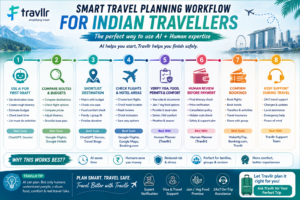 Best AI Trip Planner Workflow for Indians
Use this simple workflow.
Step 1: Ask AI for Ideas
Ask ChatGPT or Gemini:
“Suggest 5 international trips under ₹1 lakh from Chennai for a vegetarian family.”
This gives you direction.
Step 2: Ask AI to Compare
Ask:
“Compare Sri Lanka, Malaysia and Thailand by cost, food, visa and family comfort.”
Now you know which destinations fit.
Step 3: Check Maps
Open Google Maps and check hotel areas, distances and food access.
This shows the real travel effort.
Step 4: Check Flights
Use Google Flights or airline websites to understand fare ranges.
This prevents fake budget planning.
Step 5: Ask Travllr for Reality Check
Now send the shortlisted destination to Travllr.
Ask for:
- Flights
- Hotels
- Visa guidance
- Transfers
- Food support
- Activities
- Final cost
- Cancellation policy
Step 6: Book Only After Verification
Do not book only because AI made a beautiful itinerary.
Book when flights, hotels, visas and inclusions are clear.
Best Prompts for AI Trip Planning
Use better prompts to get better results.
Budget Trip Prompt
“Plan a 5-day international trip under ₹1 lakh from Chennai for an Indian vegetarian couple. Compare Thailand, Malaysia, Sri Lanka and Vietnam. Include flight logic, hotel area, food comfort and what to avoid.”
Family Trip Prompt
“Create a 6-day Singapore itinerary for an Indian family with two kids and grandparents. Keep walking low, add food comfort and avoid late nights.”
Jain Food Prompt
“Plan a 7-day Bali trip for Jain travellers. Avoid remote villas unless food is available. Include hotel areas, restaurants, snacks and full-day tour food planning.”
Senior Citizen Prompt
“Make this itinerary senior-friendly. Reduce walking, avoid hotel changes, add rest time and suggest private transfers.”
Honeymoon Prompt
“Compare Bali, Vietnam and Sri Lanka for a honeymoon from India. Keep the tone honest and include cost, food, flight time, hotel style and best months.”
Human Planner Prompt
“Review this AI itinerary like a travel planner. Tell me what is unrealistic, what needs verification and what could go wrong.”
This last prompt is very useful.
It forces AI to find problems instead of only making the trip look nice.
Best AI Trip Planner by Traveller Type
| Traveller Type | Best Tool |
|---|---|
| First-time traveller | ChatGPT + Travllr |
| Google user | Gemini + Google Maps |
| Group of friends | Wanderlog + Travllr |
| Frequent flyer | TripIt |
| Family with kids | ChatGPT draft + human planner |
| Senior citizens | Human planner first |
| Jain travellers | Human planner first |
| Budget traveller | ChatGPT + Google Flights + Travllr |
| Honeymoon couple | ChatGPT + Maps + Travllr |
| Event traveller | Human planner first |
| DIY traveller | Gemini + Maps + Wanderlog |
Best AI Trip Planner for Common Indian Trips
| Trip Type | Best Planning Combination |
|---|---|
| Thailand under ₹1 lakh | ChatGPT + Google Flights + Travllr |
| Bali honeymoon | ChatGPT + Google Maps + human planner |
| Japan family trip | ChatGPT + Google Maps + Travllr |
| Dubai short break | OTA + human planner |
| Singapore F1 | Human planner + Google Maps + ticket check |
| Ladakh | Human planner + weather/permit check |
| Kashmir | Human planner + local supplier check |
| Europe | Human planner + visa expert |
| Vietnam | ChatGPT + Google Maps + Travllr |
| Jain food trip | Human planner + food card |
Where AI Can Go Wrong
AI can make travel planning look too easy.
That is the danger.
1. It May Create Unrealistic Routes
AI may suggest too many cities in too few days.
For example, it may put Tokyo, Kyoto, Osaka, Hiroshima and Mount Fuji in one short trip.
That looks exciting.
But the traveller gets tired.
2. It May Miss Visa Changes
Visa rules change often.
AI may give outdated visa advice if it does not check live sources.
3. It May Ignore Food Reality
AI may say “vegetarian food is available.”
But Indian vegetarian, vegan and Jain food are not the same.
4. It May Underestimate Transfers
A destination may look close on a map.
In reality, traffic, ferries, mountain roads or border checks can change everything.
5. It May Suggest Bad Hotel Areas
AI may choose hotels by rating, not by location comfort.
That can create daily stress.
6. It May Miss Local Closures
Attractions can close for weather, maintenance, festivals, permits or local rules.
7. It May Give Fake Confidence
AI answers sound confident.
But confidence is not confirmation.
Always verify.
How Travllr Can Use AI Better Than Customers
Travllr should not ignore AI.
Instead, Travllr should use AI as a support tool.
AI can help Travllr:
- Draft faster itineraries
- Compare destinations
- Create packing lists
- Create blog content
- Create FAQs
- Simplify visa checklists
- Make food cards
- Create sales scripts
- Prepare client options
- Explain complicated routes simply
- Build social media content
- However, Travllr’s value comes from human checks.
Travllr should verify:
- Flights
- Hotels
- Visa rules
- Route timing
- Supplier cost
- Driver availability
- Food support
- Local rules
- Season
- Cancellation policy
- Customer comfort
This makes Travllr stronger.
Not weaker.
The future is not AI vs travel planners.
The future is AI-assisted human travel planning.
Travllr’s AI + Human Planning Model
Travllr can position itself like this:
AI helps you explore.
Travllr helps you book correctly.
That is simple and strong.
A good Travllr planning flow can be:
- AI idea generation
- Human destination filtering
- Budget reality check
- Visa check
- Hotel area check
- Food check
- Route check
- Supplier check
- Final quotation
- Booking support
- On-trip support
This gives travellers the best of both worlds.
Speed from AI.
Safety from humans.
What to Ask Travllr After Using AI
If a client comes with an AI itinerary, Travllr should ask:
- Do you want us to verify this route?
- Do you want live flight pricing?
- Do you want hotel options in good areas?
- Do you need vegetarian or Jain food?
- Are seniors travelling?
- Are kids travelling?
- Do you want private transfers?
- Do you want budget or comfort?
- Should we remove tiring days?
- Do you need visa guidance?
- Do you want a full package quote?
- This turns AI users into Travllr customers.
Because many travellers will use AI.
But they will still need someone to make it real.
Common Mistakes Indians Make with AI Trip Planners
Mistake 1: Believing the First Itinerary
AI gives a draft.
Not the final answer.
Always review it.
Mistake 2: Not Checking Live Prices
AI may estimate.
Flights and hotels can change daily.
Mistake 3: Ignoring Visa Rules
Visa can decide the whole trip.
Check official rules or ask Travllr.
Mistake 4: Overpacking the Route
AI often adds too much because it wants to be helpful.
Remove places.
A good trip needs breathing space.
Mistake 5: Not Checking Food
Vegetarian and Jain travellers should never leave food planning to chance.
Mistake 6: Choosing Hotels Without Maps
Always check hotel area on Google Maps.
Mistake 7: Not Planning Transfers
Transfers can change the cost and comfort.
Mistake 8: Booking Without Human Review
For expensive trips, get a human planner to review everything before payment.
Travllr Verdict
The best AI trip planner apps for Indians depend on what you need.
Use ChatGPT for ideas, comparisons and itinerary drafts.
Use Gemini for Google-connected planning, Maps, flights and hotels.
Use Google Maps to check location reality.
Use Wanderlog for group planning and map-based itineraries.
Use TripIt to organize confirmed bookings.
Use OTAs for search and booking options.
Use Travllr before you pay.
Because AI can plan a trip on screen.
Travllr can make it work in real life.
For Indian travellers, the best answer is not AI or human.
It is AI plus human.
That gives speed, clarity and safety.
FAQs
1. What is the best AI trip planner app for Indians?
ChatGPT, Gemini, Wanderlog, TripIt and Google Maps are useful AI or tech-assisted travel planning tools. ChatGPT works best for itinerary drafts and comparisons, while Gemini works well for Google-connected planning like Maps, flights and hotels.
2. Can ChatGPT plan a full trip?
Yes, ChatGPT can help plan a trip, create itineraries, compare destinations, make packing lists and suggest budgets. However, travellers should verify live prices, visa rules, hotel availability and local conditions before booking.
3. Is Gemini good for travel planning?
Yes, Gemini is useful for travel planning because it can connect with Google tools like Maps, Flights and Hotels in supported Gemini Apps. This helps with places, directions, flights and hotel ideas.
4. Is Wanderlog good for group trips?
Yes, Wanderlog works well for group trips because it supports collaborative planning, map-based itineraries, reservations, budgets and expense splitting.
5. Is TripIt good for travel planning?
TripIt is better for organizing confirmed bookings than for choosing a destination. It can collect flight, hotel and other booking confirmations into one itinerary when travellers forward confirmation emails.
6. Can AI replace a travel agent?
AI can help with ideas and drafts, but it should not fully replace a travel planner for complex trips. Human planners are better for visas, refunds, hotel checks, Jain food, senior comfort, supplier coordination and emergencies.
7. Which is better: AI planner or human planner?
AI is better for quick ideas. A human planner is better for final booking, verification and support. For Indian travellers, the best method is AI-assisted human planning.
8. How should I use AI before booking with Travllr?
Use AI to shortlist destinations, compare budgets and create a rough itinerary. Then ask Travllr to verify flights, hotels, visa rules, transfers, food comfort, route timing and final cost.
Conclusion
AI trip planners are useful.
- They save time.
- They create ideas.
- They compare destinations.
- They make itineraries.
- They help with packing.
- They simplify confusing plans.
But travel is not only a document.
Travel is flights, hotels, visas, weather, food, money, transfers, people and real-time changes.
That is where human planning still matters.
Use ChatGPT for the first draft.
Use Gemini for Google-connected planning.
Use Google Maps for location reality.
Use Wanderlog for group planning.
Use TripIt for booking organization.
Then use Travllr to make the trip real.
That is the smartest way to plan travel in 2026.
Try Travllr’s human-assisted trip planning and turn your AI itinerary into a verified trip with flights, hotels, visa guidance, transfers, food planning and real support.
Leave a Reply