The Amarnath Yatra 2026 is scheduled from 3 July to 28 August 2026. Pilgrims must complete registration, submit a valid Compulsory Health Certificate, carry original ID and collect the mandatory RFID card before starting the Yatra. Advance registration through designated bank branches began from 15 April 2026, and the medical certificate must be issued on or after 8 April 2026.
For most pilgrims, the safest planning method is simple: register early, get the medical certificate only from an authorised doctor, choose the correct route, pack for cold and rain, and keep checking official weather and route updates before travelling.
First, Understand This Is Not a Normal Hill Trip
Amarnath Yatra is not a casual Kashmir holiday.
It is a spiritual journey.
It is emotional.
It is powerful.
It is also physically demanding.
Many pilgrims focus only on darshan.
But the journey needs preparation.
The route has steep climbs.
The weather can change suddenly.
The temperature can drop sharply.
The altitude can affect breathing.
Crowds can slow movement.
Routes can pause because of weather.
Documents matter.
Medical fitness matters.
So Travllr should never plan Amarnath like a normal sightseeing package.
A good Amarnath Yatra plan should protect the pilgrim first.
Darshan comes with devotion.
But safety comes with planning.
Amarnath Yatra 2026: Quick Snapshot
| Planning Area | 2026 Details |
|---|---|
| Yatra dates | 3 July to 28 August 2026 |
| Registration start | 15 April 2026 |
| Medical certificate validity | CHC issued on or after 8 April 2026 |
| Age limit | Below 13 and above 70 not allowed |
| Pregnancy rule | Women with more than 6 weeks pregnancy not allowed |
| Main routes | Pahalgam route and Baltal route |
| RFID card | Mandatory before starting the Yatra |
| Helicopter status | Not available in Yatra area for 2026 due No Flying Zone notice |
| Best approach | Register early, prepare physically, check route/weather updates |
| CTA | Get Amarnath Yatra assistance from Travllr |
The official Shrine Board homepage states that the Yatra routes, including both Pahalgam and Baltal axes, have been declared a No Flying Zone from 1 July 2026 till completion of the Yatra, so helicopter services for pilgrim travel are not available in the Yatra area for SANJY 2026. Pilgrims may proceed on foot or use ponies/palkis.
Who Should Plan the Amarnath Yatra?
Plan this Yatra if:
- You are physically fit.
- You can walk or ride safely in mountain terrain.
- You can handle cold and rain.
- You can follow official rules.
- You can manage basic facilities.
- You can prepare documents early.
- You can travel with patience.
- You understand that weather can affect the route.
The Yatra works best for pilgrims who respect the mountain conditions and follow the Shrine Board’s safety instructions.
Who Should Avoid or Reconsider the Yatra?
Avoid or reconsider the Yatra if:
- You are below 13 years.
- You are above 70 years.
- You are pregnant for more than 6 weeks.
- You have serious heart, breathing or mobility issues.
- You cannot manage cold weather.
- You cannot handle altitude.
- You cannot walk safely on uneven terrain.
- You are planning without valid registration.
- You are expecting a luxury trip.
The official health advisory says persons below 13 years and above 70 years are not allowed, and women with more than six weeks of pregnancy are not allowed.
Travllr should also advise pilgrims with medical conditions to consult their own doctor before planning.
Amarnath Yatra Registration 2026
Registration is the first real step.
Do not book the trip first and think about registration later.
For 2026, advance registration through designated bank branches began on 15 April 2026. The official bank-registration procedure says registration and Yatra permit issuance happen on a first-come, first-served basis, and each designated bank branch has a fixed daily route quota.
This means pilgrims should not wait until the last minute.
Registration depends on:
- Available date
- Available route
- Daily quota
- Valid CHC
- Correct documents
- Aadhaar-based biometric eKYC
- Bank branch availability
- Route-wise permit availability
Travllr should help pilgrims understand that registration confirms a specific date and route.
You cannot treat it like an open travel pass.
Registration Documents Checklist
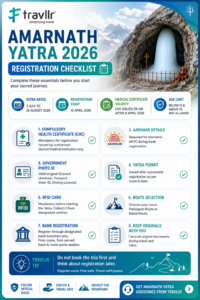
| Document | Why It Matters |
|---|---|
| Valid Compulsory Health Certificate | Mandatory for registration |
| Aadhaar details | Used for biometric eKYC during bank registration |
| Government photo ID | Needed during travel and verification |
| Passport-size photo | Useful for forms and records |
| Mobile number | Captured during registration |
| Registration fee receipt | Required at bank registration |
| Yatra Permit | Route and date confirmation |
| RFID card | Mandatory before starting Yatra |
The official bank-registration procedure says every pilgrim must submit a valid CHC and fee receipt, and the bank issues a Yatra Permit after verification. It also says the permit carries the route name, either “BALTAL” or “PAHALGAM.”
Compulsory Health Certificate: What Pilgrims Must Know
The Compulsory Health Certificate, also called CHC, is not a formality.
It proves that the pilgrim is medically fit for a high-altitude Yatra.
For 2026, the CHC must be issued on or after 8 April 2026 and must come from an authorised doctor or medical institution. The Shrine Board lists state-wise authorised doctors and institutions for issuing the CHC.
Do not take a certificate from a random clinic unless it appears on the authorised list.
A wrong certificate can create registration problems.
Travllr Tip
Get the CHC before registration, but make sure it follows the 2026 rule.
For 2026, a CHC issued before 8 April 2026 will not work.
CHC Checklist
Before submitting the CHC, check:
- Is it in the official format?
- Was it issued on or after 8 April 2026?
- Was it issued by an authorised doctor or institution?
- Does it have the pilgrim’s photo?
- Is the photo attested by the authorised doctor?
- Are the details readable?
- Does the name match the ID proof?
- Is the original copy available?
- Is the scanned copy clear, if registering online?
- Does the pilgrim carry the original during Yatra?
The official Shrine Board health advisory also says pilgrims must carry the original Photo ID and Medical Certificate during the Yatra.
RFID Card: Do Not Miss This Step
The RFID card is mandatory.
The Shrine Board’s official instructions say every registered Yatri must collect the RFID card from designated locations in Jammu or Kashmir Division before starting the Yatra, carry Aadhaar details for RFID collection, and wear the RFID tag around the neck at all times during the Yatra.
This is for safety and tracking.
Do not treat it like an optional ID card.
Travllr Tip
Build RFID collection into the itinerary.
Do not make pilgrims rush from arrival point directly to the Yatra route without collecting RFID.
Amarnath Yatra Routes: Pahalgam vs Baltal
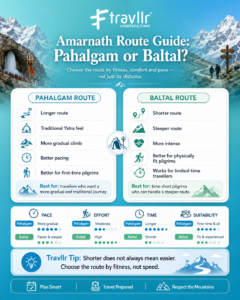
There are two main routes:
Pahalgam route
Baltal route
The Shrine Board’s route page lists the traditional route as Jammu → Pahalgam → Chandanwari → Pissu Top → Sheshnag → Panchtarni → Holy Cave and the Baltal route as Jammu → Baltal → Domail → Barari → Holy Cave.
Both routes reach the same Holy Cave.
But the travel style feels very different.
Route Comparison Table
| Factor | Pahalgam Route | Baltal Route |
|---|---|---|
| Travel feel | Longer, traditional, more gradual | Shorter, steeper, more intense |
| Best for | Pilgrims who want traditional Yatra flow | Pilgrims with less time and strong fitness |
| Physical demand | Spread over more time | More demanding in a shorter stretch |
| Comfort | Usually easier to pace | Can feel rushed and tough |
| Time needed | More days | Fewer days |
| Travllr advice | Better for first-time comfort pilgrims | Choose only if health and fitness support it |
Travllr should not recommend Baltal only because it is shorter.
Shorter does not always mean easier.
For many pilgrims, the longer Pahalgam route feels more manageable because the effort spreads out.
Which Route Should Pilgrims Choose?
Choose Pahalgam route if:
- You want the traditional route.
- You want better pacing.
- You are doing the Yatra for the first time.
- You want a more gradual journey.
- You can spare more days.
- You do not want to rush.
Choose Baltal route if:
- You have limited time.
- You are physically fit.
- You can manage steeper terrain.
- You understand that the shorter route can feel tougher.
- You are comfortable with a more intense Yatra day.
Travllr verdict:
For most first-time pilgrims and families, Pahalgam route is safer for pacing.
For time-limited but physically strong pilgrims, Baltal can work.
Suggested 5-Day Amarnath Yatra Plan
A simple 5-day plan works for many pilgrims using the Baltal side or a tighter route.
| Day | Plan |
|---|---|
| Day 1 | Arrive in Srinagar or Jammu, transfer to base area, document/RFID check |
| Day 2 | Move towards Baltal / route base, acclimatise and rest |
| Day 3 | Yatra day to Holy Cave and return as per route permission and fitness |
| Day 4 | Buffer day for weather, rest or return movement |
| Day 5 | Departure from Srinagar/Jammu |
This plan needs strong weather checking and correct official permissions.
Do not keep the departure flight too tight after the Yatra day.
Suggested 6–7 Day Amarnath Yatra Plan
A slightly longer plan works better for comfort.
| Day | Plan |
|---|---|
| Day 1 | Arrive in Jammu / Srinagar |
| Day 2 | Transfer to Pahalgam or Baltal-side base |
| Day 3 | Acclimatisation, RFID, document check, final preparation |
| Day 4 | Start Yatra as per registered route/date |
| Day 5 | Continue/complete Yatra movement as per route |
| Day 6 | Return and rest |
| Day 7 | Departure |
This plan gives more breathing space.
For older pilgrims within the permitted age bracket, Travllr should avoid a rushed itinerary.
Helicopter Services: 2026 Important Update
Many older Amarnath plans mention helicopter service.
But for SANJY 2026, the Shrine Board’s official notice states that all routes of the Yatra, including Pahalgam and Baltal axes, were declared a No Flying Zone from 1 July 2026 till completion of the Yatra. The notice says helicopter services for pilgrim travel will not be available in the Yatra area.
This is very important.
Travllr should not sell helicopter-based Amarnath Yatra packages for 2026 unless the official notice changes.
Before publishing or selling any package, recheck the current Shrine Board notice.
Weather and Route Updates Matter
Amarnath Yatra routes can be affected by weather.
Rain, landslides, slippery paths and mountain conditions can pause movement.
The official Shrine Board homepage recently carried an adverse-weather notice saying the Yatra would remain temporarily suspended from both Pahalgam and Baltal routes with effect from 19 July 2026.
This proves one thing clearly:
Do not plan Amarnath with zero buffer.
Travllr should always add:
- Weather check
- Route-status check
- Buffer day
- Flexible transport
- Safe departure timing
- Emergency contact support
Physical Preparation Before Amarnath Yatra
Pilgrims should start fitness preparation at least a month before the Yatra.
The Shrine Board health advisory recommends morning or evening walks of around 4–5 km per day at least a month before the Yatra, along with deep breathing exercises and pranayam to improve oxygen efficiency.
This is not optional advice.
It directly affects comfort.
Simple Preparation Plan
- Start walking daily.
- Use stairs slowly.
- Practice deep breathing.
- Improve stamina.
- Avoid last-minute fitness panic.
- Break in your trekking shoes before travel.
- Consult a doctor if you have medical issues.
- Keep medicines ready.
A pilgrim who prepares early will manage the Yatra much better.
High-Altitude Health Tips
The Yatra involves high altitude, so pilgrims should watch symptoms seriously.
Possible symptoms include:
- Headache
- Breathlessness
- Dizziness
- Nausea
- Fatigue
- Confusion
- Chest discomfort
- Loss of balance
- weakness
The Shrine Board health advisory says pilgrims should descend immediately to a lower elevation if they start having altitude illness symptoms and contact the nearest medical facility in case of high-altitude sickness or discomfort.
Do not ignore symptoms to “complete darshan somehow.”
Health comes first.
Food and Hydration Tips
The official health advisory asks pilgrims to drink plenty of water to combat dehydration and headaches and to consume carbohydrates to reduce fatigue and prevent low blood sugar.
Carry simple, travel-safe food.
Good options include:
- Dry fruits
- Energy bars
- Glucose biscuits
- Khakhra
- Thepla
- Makhana
- ORS
- Jaggery or chikki
- Light snacks
- Tea sachets if needed
- Medicines as prescribed
Do not overeat heavy food before the trek.
Keep meals light and energy-focused.
Packing Checklist for Amarnath Yatra
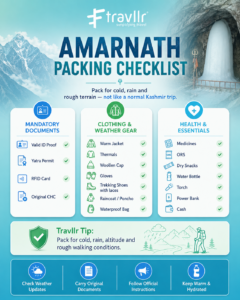
Pack for cold, rain and rough terrain.
Must Carry
- Valid ID proof
- Yatra Permit
- RFID card
- CHC
- Medicines
- Warm jacket
- Thermal wear
- Woollen cap
- Gloves
- Woollen socks
- Trekking shoes with laces
- Raincoat or poncho
- Windcheater
- Waterproof bag
- Small backpack
- Torch
- Power bank
- Water bottle
- Dry snacks
- ORS
- Sunscreen
- Lip balm
- Moisturiser
- Extra clothes
- Cash
- Emergency contact note
The Shrine Board’s official do’s advise pilgrims to carry woollen clothing because temperature can fall below 5°C, and to carry an umbrella, windcheater, raincoat and waterproof shoes because the weather in the Yatra area is unpredictable.
What Not to Wear or Carry
Avoid:
- Slippers
- Open sandals
- Heavy luggage
- Cotton-only clothing
- Uncomfortable shoes
- Loose plastic bags
- Too many valuables
- Alcohol
- Cigarettes
- Unnecessary electronics
- Large suitcases
- Risky shortcuts
- Unverified medicines
The Shrine Board’s official don’ts clearly say pilgrims should not use slippers because the route has steep rises and falls, and should wear trekking shoes with laces. It also says pilgrims should not attempt shortcuts.
Travllr’s Amarnath Yatra Planning Method
Travllr should plan Amarnath in this order:
Step 1: Check Eligibility
Age, pregnancy rule, health condition and fitness.
Step 2: Check Registration
Date, route, quota and permit process.
Step 3: Get CHC
Only from authorised doctor or institution.
Step 4: Plan Route
Pahalgam or Baltal based on fitness and time.
Step 5: Build Itinerary
Add arrival, RFID collection, rest, Yatra day and buffer day.
Step 6: Plan Packing
Cold, rain, shoes, documents and medicines.
Step 7: Monitor Updates
Weather, route status, security and official Shrine Board notices.
This makes the trip safer and cleaner.
Common Amarnath Yatra Mistakes
Mistake 1: Planning without registration
No valid registration means no Yatra.
Do not travel first and hope for adjustment.
Mistake 2: Getting the wrong medical certificate
The CHC must come from an authorised doctor or institution and follow the 2026 date rule.
Mistake 3: Ignoring RFID collection
No RFID card means the pilgrim cannot embark on the Yatra.
Mistake 4: Choosing Baltal only because it is shorter
Baltal is shorter but steeper.
Choose it only if fitness supports it.
Mistake 5: Packing like a normal Kashmir trip
Amarnath needs trekking shoes, woollens, rain protection and waterproof packing.
Mistake 6: Ignoring altitude symptoms
Headache, breathlessness and dizziness need attention.
Mistake 7: Booking tight return travel
Weather can delay the Yatra.
Keep buffer.
Mistake 8: Believing old helicopter package details
For 2026, official notice says helicopter services are not available in the Yatra area due to the No Flying Zone order.
Travllr Verdict
The Amarnath Yatra Guide 2026 is simple if pilgrims follow the right order.
- Register first.
- Get the correct medical certificate.
- Collect the RFID card.
- Choose the right route.
- Prepare your body.
- Pack for cold and rain.
- Follow official instructions.
- Keep a buffer for weather.
For first-time pilgrims, Travllr should usually recommend a slower and safer plan instead of a rushed one.
The Yatra is not about speed.
It is about devotion, discipline and safe completion.
FAQs
1. What are the Amarnath Yatra 2026 dates?
The Amarnath Yatra 2026 is scheduled from 3 July to 28 August 2026. Pilgrims should still check official Shrine Board updates before travel because weather and operational changes can affect movement.
2. When did Amarnath Yatra 2026 registration start?
Advance registration through designated bank branches began on 15 April 2026. Registration works on a first-come, first-served basis and depends on route/date quota.
3. Is a medical certificate compulsory for Amarnath Yatra?
Yes, the Compulsory Health Certificate is mandatory. For 2026, the CHC must be issued on or after 8 April 2026 by an authorised doctor or medical institution.
4. What is the age limit for Amarnath Yatra?
Pilgrims below 13 years and above 70 years are not allowed. Women with more than 6 weeks of pregnancy are also not allowed.
5. Is RFID mandatory for Amarnath Yatra?
Yes, RFID is mandatory. Registered pilgrims must collect the RFID card from designated locations in Jammu or Kashmir Division before starting the Yatra and wear it during the Yatra.
6. Which Amarnath route is better: Pahalgam or Baltal?
Pahalgam is usually better for pilgrims who want a more gradual traditional route. Baltal is shorter but steeper and suits physically fit pilgrims with limited time. Travllr should choose the route based on health, time and comfort.
7. Are helicopters available for Amarnath Yatra 2026?
As per the official Shrine Board notice, helicopter services for pilgrim travel are not available in the Yatra area during SANJY 2026 because the routes have been declared a No Flying Zone from 1 July 2026 till completion of the Yatra.
8. What should I pack for Amarnath Yatra?
Carry ID proof, Yatra Permit, RFID card, original CHC, woollens, raincoat, windcheater, waterproof shoes, trekking shoes with laces, medicines, snacks, ORS, water bottle, torch, power bank and waterproof bag.
Conclusion
Amarnath Yatra is one of India’s most powerful spiritual journeys.
But it needs respect and preparation.
Do not plan it casually.
Do not skip registration.
Do not use the wrong medical certificate.
Do not ignore RFID.
Do not pack badly.
Do not ignore altitude symptoms.
Do not rely on old helicopter information.
Do not travel without checking weather and route status.
Plan early.
Prepare your body.
Follow the Shrine Board’s instructions.
Choose the route that suits your health.
That is how the Yatra becomes safer, smoother and spiritually fulfilling.
Get Amarnath Yatra assistance from Travllr with registration guidance, CHC checklist, route planning, packing support, stay coordination, transport planning and official-update reminders.
Leave a Reply